

The Vietnamese real estate market is shedding its emerging skin. For the past decade, the playbook for developing property in the country was anchored in speed: build quickly, capture immediate demand, and capitalize on rapid urban growth. However, as the market moves through 2026, a profound shift is occurring, driven by a global investment community that values institutional substance over mere volume.
Leading this narrative is David Jackson, Principal and CEO of Avison Young Vietnam and Cambodia. With nearly two decades of commercial real estate experience in the region, including his foundational years in Vietnam starting in 2008, Jackson has witnessed the market's transition from a speculative playground into a structured, data-driven landscape.
Leading this narrative is David Jackson, Principal and CEO of Avison Young Vietnam and Cambodia. With nearly two decades of commercial real estate experience in the region, including his foundational years in Vietnam starting in 2008, Jackson has witnessed the market's transition from a speculative playground into a structured, data-driven landscape.
The Institutional Phase: Allocating with Intent
Vietnam is formalizing at a rapid pace, backed by a population of over 100 million, a surging middle class, and a strategic geography right alongside China that embeds it deeply into regional manufacturing and tourism supply chains. These strong fundamentals are shifting how international financiers view the country's risk profile.
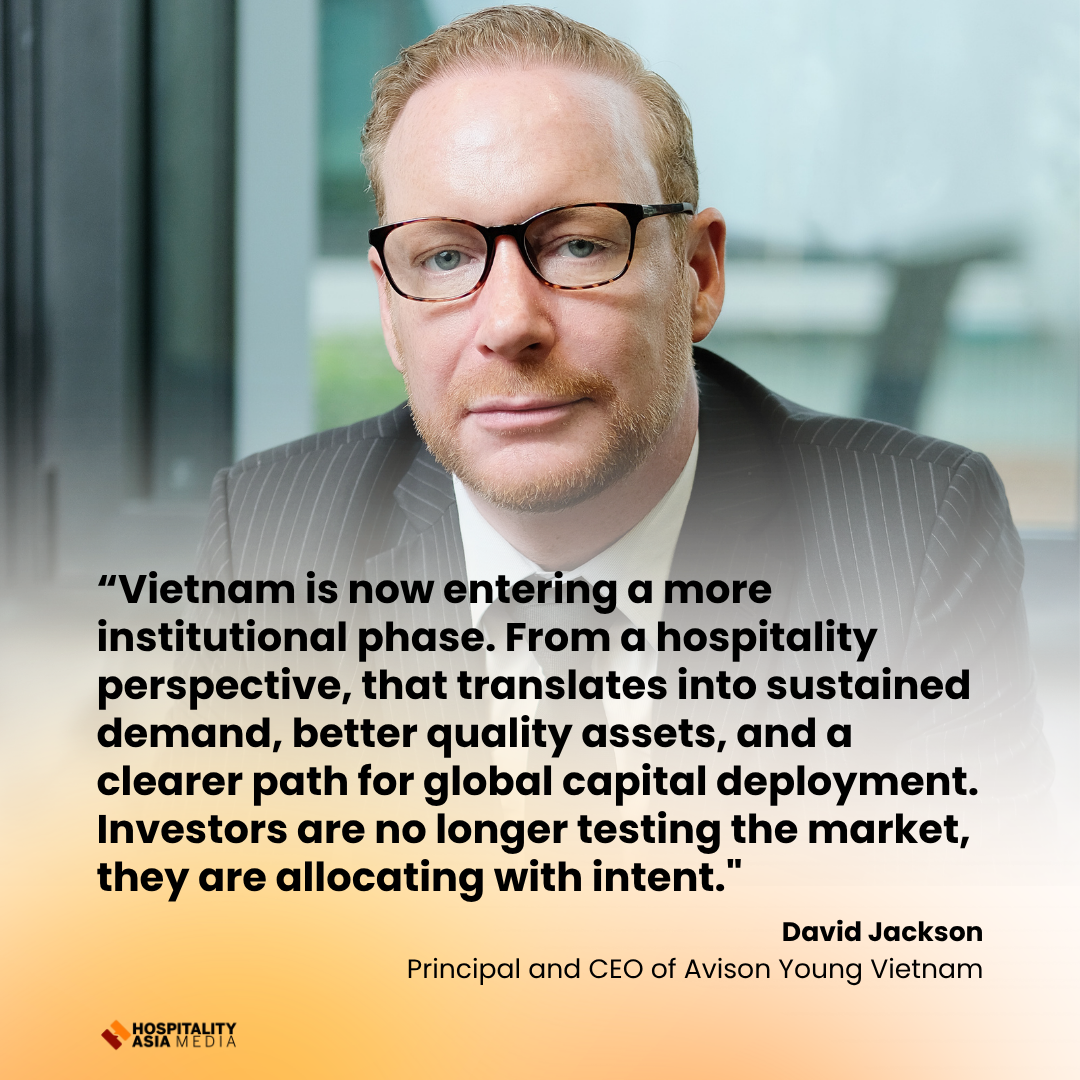
"Vietnam is now entering a more institutional phase," Jackson observes. "From a hospitality perspective, that translates into sustained demand, better quality assets, and a clearer path for global capital deployment. Investors are no longer testing the market, they are allocating with intent."
The old view that Vietnam is a high-risk or unpredictable market is increasingly outdated. According to Jackson, the real shift right now is from exploration to execution, driven by tangible infrastructure growth that is reshaping the physical and regulatory landscape of the country.
"Vietnam is now entering a more institutional phase," Jackson observes. "From a hospitality perspective, that translates into sustained demand, better quality assets, and a clearer path for global capital deployment. Investors are no longer testing the market, they are allocating with intent."
The old view that Vietnam is a high-risk or unpredictable market is increasingly outdated. According to Jackson, the real shift right now is from exploration to execution, driven by tangible infrastructure growth that is reshaping the physical and regulatory landscape of the country.
Uncovering Undervalued Corridors
For developers looking to outpace the market, Jackson notes that primary hubs like Ho Chi Minh City will always serve as core anchors, but the most compelling entry points exist where infrastructure and land value have not yet fully aligned.
In Central Vietnam, the coastal city of Da Nang is transitioning away from its historical identity as a brief seaside stopover. A wave of large-scale, integrated planning aims to reposition the hub into a comprehensive entertainment ecosystem.
"There are a number of large-scale projects in the planning stage that will shift it from a short stay destination into something much more compelling. Think broader entertainment, integrated resorts, and 'stay longer' experiences, closer to a Disneyland style positioning than a quick beach stop. That change alone will redefine demand."
For developers aiming to get entirely ahead of the curve, Jackson highlights Quy Nhon and Phu Yen as regions boasting strong coastlines and improving accessibility without the stifling density of mature markets. In the north, the infrastructure upgrades rippling through Quang Ninh and the wider Ha Long area continue to create fertile ground for highly differentiated boutique and experiential concepts.
In Central Vietnam, the coastal city of Da Nang is transitioning away from its historical identity as a brief seaside stopover. A wave of large-scale, integrated planning aims to reposition the hub into a comprehensive entertainment ecosystem.
"There are a number of large-scale projects in the planning stage that will shift it from a short stay destination into something much more compelling. Think broader entertainment, integrated resorts, and 'stay longer' experiences, closer to a Disneyland style positioning than a quick beach stop. That change alone will redefine demand."
For developers aiming to get entirely ahead of the curve, Jackson highlights Quy Nhon and Phu Yen as regions boasting strong coastlines and improving accessibility without the stifling density of mature markets. In the north, the infrastructure upgrades rippling through Quang Ninh and the wider Ha Long area continue to create fertile ground for highly differentiated boutique and experiential concepts.
The Three Pillars of Global Capital Readiness
Global institutional funds are arriving in Vietnam with significantly higher expectations than in previous cycles. Jackson outlines a strict three-part checklist for any developer seeking international equity:
This rigor is particularly vital in hot, fast-growing segments like branded residences, which have seen a surge in popularity across Vietnam. Jackson acknowledges the viability of the asset class but notes that a clear line is being drawn between marketing hype and operational reality.
"We are starting to see more projects using branding as a marketing tool rather than an operational commitment, and that is where the risk sits. Over time, that will separate the market. The well executed, genuinely branded assets will hold value. The rest will struggle."
- Market-Driven Strategy: Moving away from concept-led vanity projects toward rigorous, demand-backed placement.
- Operational Credibility: Harmonizing experience-led design with proven hospitality management to capture Millennial spend.
- Governance and ESG: Maintaining clean legal title, transparent corporate structures, and verifiable sustainability frameworks.
This rigor is particularly vital in hot, fast-growing segments like branded residences, which have seen a surge in popularity across Vietnam. Jackson acknowledges the viability of the asset class but notes that a clear line is being drawn between marketing hype and operational reality.
"We are starting to see more projects using branding as a marketing tool rather than an operational commitment, and that is where the risk sits. Over time, that will separate the market. The well executed, genuinely branded assets will hold value. The rest will struggle."
ESG as a Tool for Value Liquidity
The integration of Environmental, Social, and Governance (ESG) criteria has completely evolved from an optional public relations exercise into a direct metric of real estate valuation in Southeast Asia. With volatile fuel and energy costs, the commercial case for efficient building performance has become undeniable, backed by a government that is actively pushing sustainability targets.
"ESG is now a real driver of value and liquidity. It is no longer optional," Jackson emphasizes. "Investors are factoring it directly into decisions, and assets that fall short are either discounted or overlooked. In simple terms, strong ESG protects value. Weak ESG erodes it."
"ESG is now a real driver of value and liquidity. It is no longer optional," Jackson emphasizes. "Investors are factoring it directly into decisions, and assets that fall short are either discounted or overlooked. In simple terms, strong ESG protects value. Weak ESG erodes it."

The Path to 2030: Substance Over Scale
Looking toward the end of the decade, Jackson predicts that the overarching theme for the Vietnamese landscape will be a decisive pivot from sheer growth to operational quality. The market is already correcting away from short-term speculative products, such as unaligned investment townhouses designed for rapid flipping toward genuine, master-planned communities designed for long-term utility.
Jackson points to cautionary structural lessons from broader regional markets as a stark reminder of what happens when volume outpaces genuine absorption.
"We have seen in parts of China what happens when development is driven by volume alone, entire 'ghost cities' with limited real demand. It is a clear reminder that scale without substance does not create long term value. The market is moving away from building more, toward building better."
Jackson points to cautionary structural lessons from broader regional markets as a stark reminder of what happens when volume outpaces genuine absorption.
"We have seen in parts of China what happens when development is driven by volume alone, entire 'ghost cities' with limited real demand. It is a clear reminder that scale without substance does not create long term value. The market is moving away from building more, toward building better."
About David Jackson
David Jackson is the Principal and Chief Executive Officer of Avison Young in Vietnam and Cambodia. With nearly 20 years of commercial real estate expertise in Indochina, he directs strategic vision, asset valuation, and investment consultancy for major institutional clients across the region.