
The term "AI-enabled" currently gets attached to everything from a basic scheduling tool to a fully autonomous booking engine. That breadth is precisely why the term causes so much confusion. For hotel and venue sales teams, that confusion comes at a direct financial cost. Event planners routinely send the same RFP to multiple properties simultaneously. Sales teams holding off on AI adoption are actively losing proposals to competitors who reply faster, while teams rushing in blindly often haven't determined which exact operational bottleneck they are trying to solve.
Felix Undeutsch, CEO of hivr.ai, iVvy's AI partner for venue sales, clarifies where industry myths end and operational reality begins.
Felix Undeutsch, CEO of hivr.ai, iVvy's AI partner for venue sales, clarifies where industry myths end and operational reality begins.
The Fear: Will AI Replace Venue Sales Teams?
Industry professionals frequently express concern that AI will eliminate venue and event jobs. In reality, the strategic goal of AI deployment is to bring people back into direct contact with people.
By automating manual tasks like data entry, baseline pricing, and availability checks, sales teams spend less time navigating software systems and more time engaging clients. Given that hotels continue to face recruitment challenges for experienced sales talent, maximizing the output and reach of existing personnel is essential.
Looking closely at how sales hours are actually spent, representatives handling inbound RFPs and proposals spend a surprisingly small fraction of their workday on relationship management, the primary skill for which they were hired. Most of their day is consumed by repetitive administrative maintenance. Industry research indicates that sales representatives across sectors spend a mere 28–40% of their time on core selling and relationship building; the remaining 60–72% is swallowed by CRM updates, manual drafting, and internal admin tasks. Frankly, many convention sales managers are operating more as "convention admin managers."
By automating manual tasks like data entry, baseline pricing, and availability checks, sales teams spend less time navigating software systems and more time engaging clients. Given that hotels continue to face recruitment challenges for experienced sales talent, maximizing the output and reach of existing personnel is essential.
Looking closely at how sales hours are actually spent, representatives handling inbound RFPs and proposals spend a surprisingly small fraction of their workday on relationship management, the primary skill for which they were hired. Most of their day is consumed by repetitive administrative maintenance. Industry research indicates that sales representatives across sectors spend a mere 28–40% of their time on core selling and relationship building; the remaining 60–72% is swallowed by CRM updates, manual drafting, and internal admin tasks. Frankly, many convention sales managers are operating more as "convention admin managers."
The Distinctions: AI Assistant vs. AI Agent
A common misconception among venue operators is that deploying a basic chatbot means they have fully adopted AI. A fundamental distinction exists between an AI assistant and an AI agent:
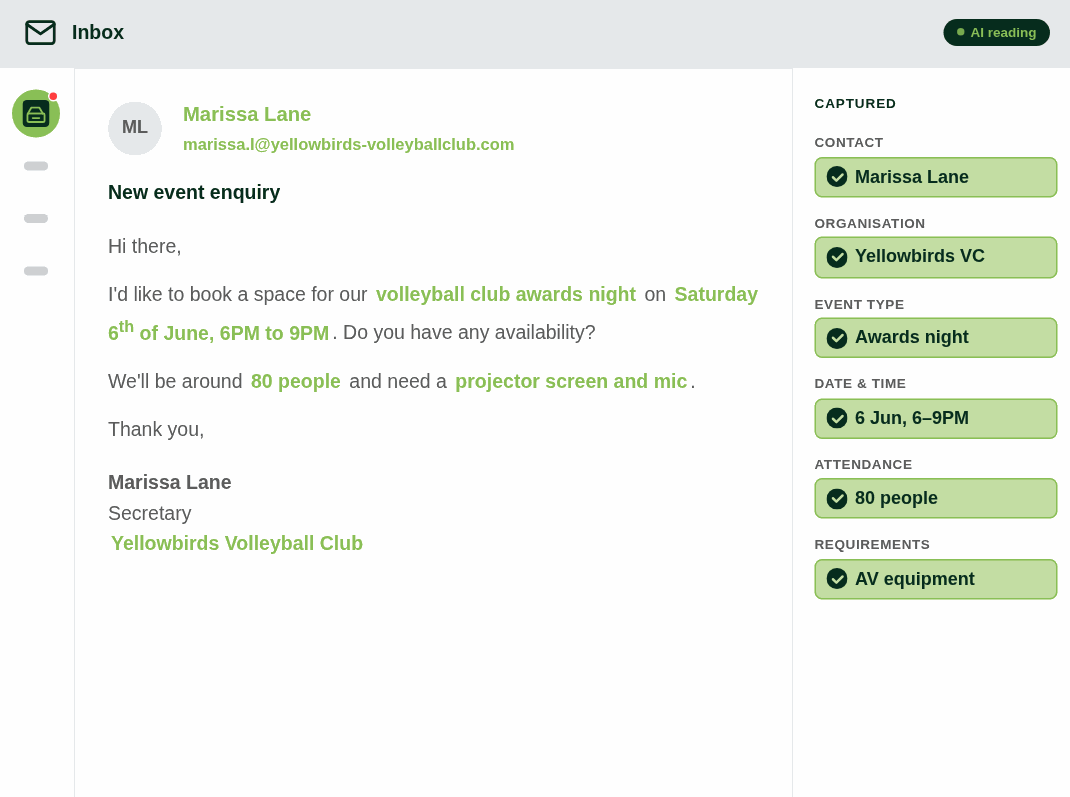
Consider an operational example like iVvyAI’s Instant Proposal – Email. The underlying AI agent reads an inbound venue inquiry, accurately classifies it (e.g., distinguishing a new meeting request from an invoice query or spam), interprets the core requirements, and initiates the appropriate next steps. Critically, this agent model operates under human oversight, guarded and steered by custom rules and configuration settings.
- AI Assistant: Generates static content, such as text or images in direct response to a specific human prompt.
- AI Agent: Evaluates contextual information, determines necessary downstream actions, and executes multi-step workflows toward a defined objective.
Consider an operational example like iVvyAI’s Instant Proposal – Email. The underlying AI agent reads an inbound venue inquiry, accurately classifies it (e.g., distinguishing a new meeting request from an invoice query or spam), interprets the core requirements, and initiates the appropriate next steps. Critically, this agent model operates under human oversight, guarded and steered by custom rules and configuration settings.
The True Cost of Inaction
Venues that delay AI implementation suffer from two major competitive disadvantages:
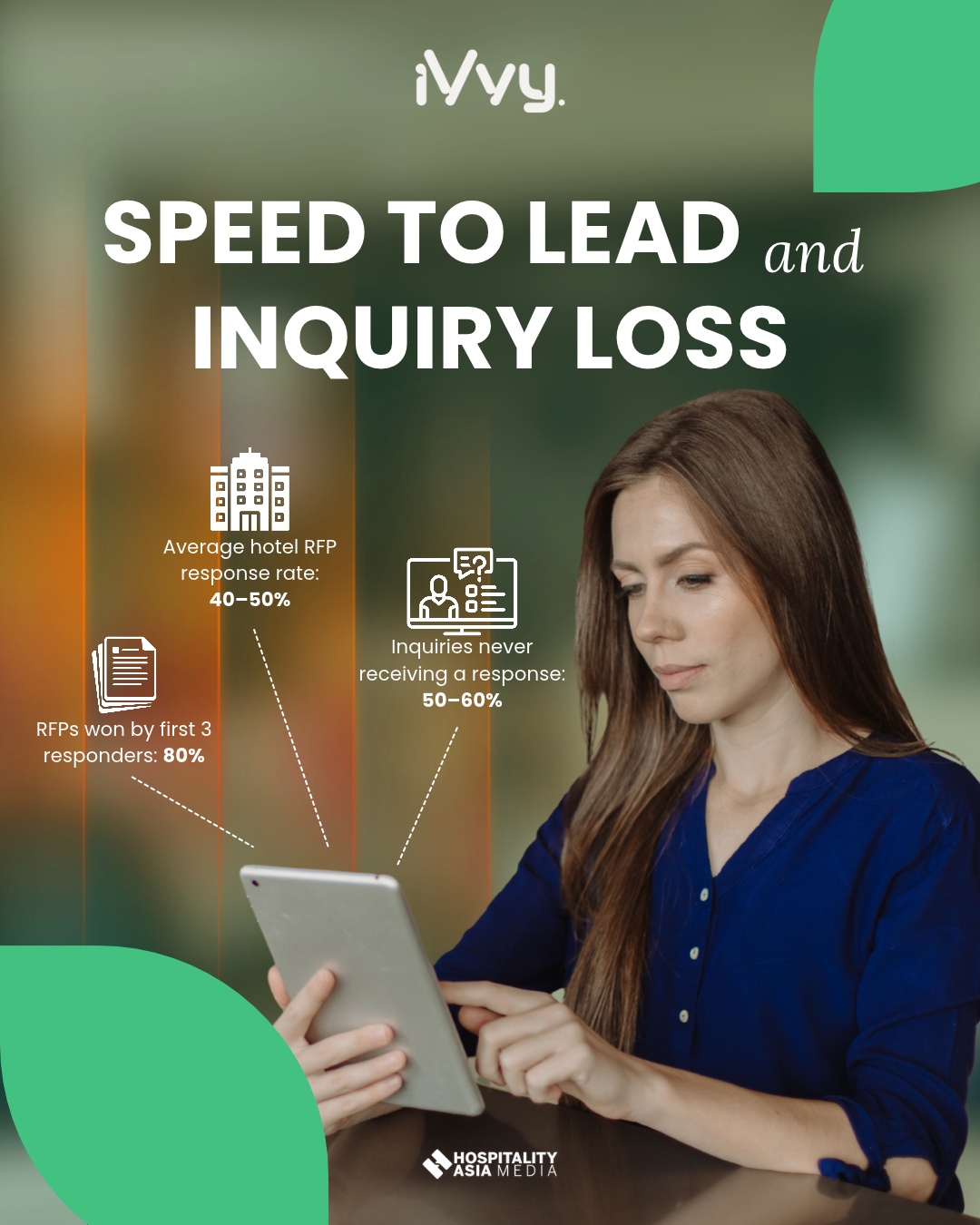
- Loss of Speed: Industry data shows that 80% of RFPs are won by the first three properties to respond. Yet, the average hotel RFP response rate hovers around 40–50%, meaning over half of all inbound inquiries never receive a reply at all.
- Loss of Focus: Properties utilizing AI free their staff to concentrate on elevated customer service—the precise differentiator that sets a property apart. This is not inherently a cost-cutting strategy; it is an optimization strategy designed to maximize the impact of experienced team members by redirecting them toward high-value human interactions.
Measuring Success: Leading vs. Lagging Metrics
Evaluating the success of an AI rollout requires prioritizing leading indicators over lagging ones. Critical metrics to track include:
To begin tracking your venue's performance indicators, download iVvy's free resource: 15 Metrics for More Venue Bookings.
- The percentage of proposals drafted by AI versus manual creation
- Average proposal turnaround time
- Overall inquiry response rate
To begin tracking your venue's performance indicators, download iVvy's free resource: 15 Metrics for More Venue Bookings.
About iVvy
iVvy is an Event & Venue Management Software designed to function like an additional team member. We empower hospitality venues, hotels, and event spaces to respond to inquiries faster, gain deep business visibility, and accomplish more with streamlined resources. Trusted by thousands of venues globally, iVvy helps teams save time, increase productivity, and deliver exceptional event experiences. Learn more at ivvy.com.