
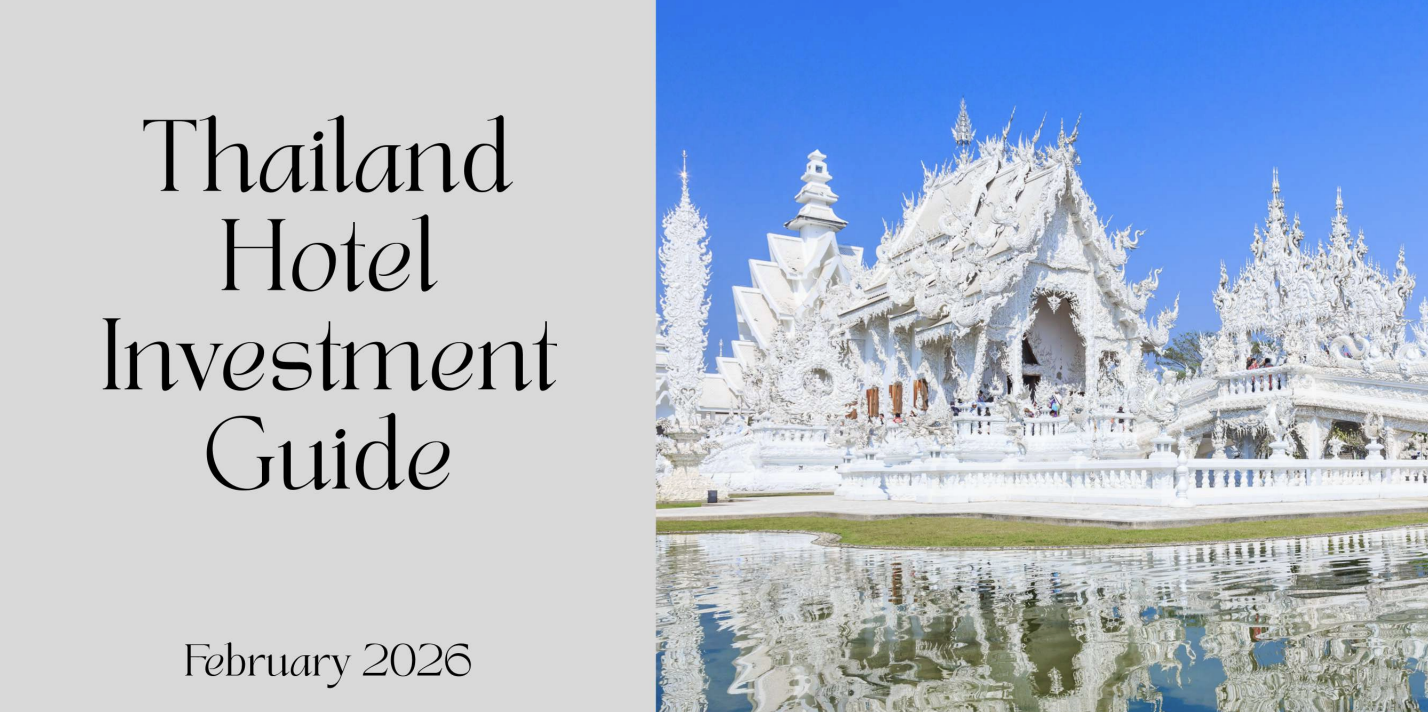
C9 Hotelworks, in collaboration with Watson Farley & Williams, presents the Thailand Hotel Investment Guide 2026, providing a comprehensive review of tourism demand dynamics, hotel performance trends, key destination insights, infrastructure catalysts, the hotel investment lending landscape, sustainability implications, and legal considerations shaping Thailand's hospitality investment environment.
Thailand recorded approximately 33 million international arrivals in 2025, with total tourism revenue reaching THB2.9 trillion. While Chinese arrivals remain below historical levels, demand diversification across Malaysia, India, Russia, the UK, and the US has strengthened resilience. According to the Tourism Authority of Thailand, international arrivals are projected at approximately 35 million in 2026, reflecting continued government-led tourism initiatives and sustained destination confidence. The report finds increasing performance dispersion across Thai markets, an active but disciplined lending environment, and a structured legal framework that together define the investment proposition heading into 2026.
Thailand recorded approximately 33 million international arrivals in 2025, with total tourism revenue reaching THB2.9 trillion. While Chinese arrivals remain below historical levels, demand diversification across Malaysia, India, Russia, the UK, and the US has strengthened resilience. According to the Tourism Authority of Thailand, international arrivals are projected at approximately 35 million in 2026, reflecting continued government-led tourism initiatives and sustained destination confidence. The report finds increasing performance dispersion across Thai markets, an active but disciplined lending environment, and a structured legal framework that together define the investment proposition heading into 2026.
Key Insights from the Report
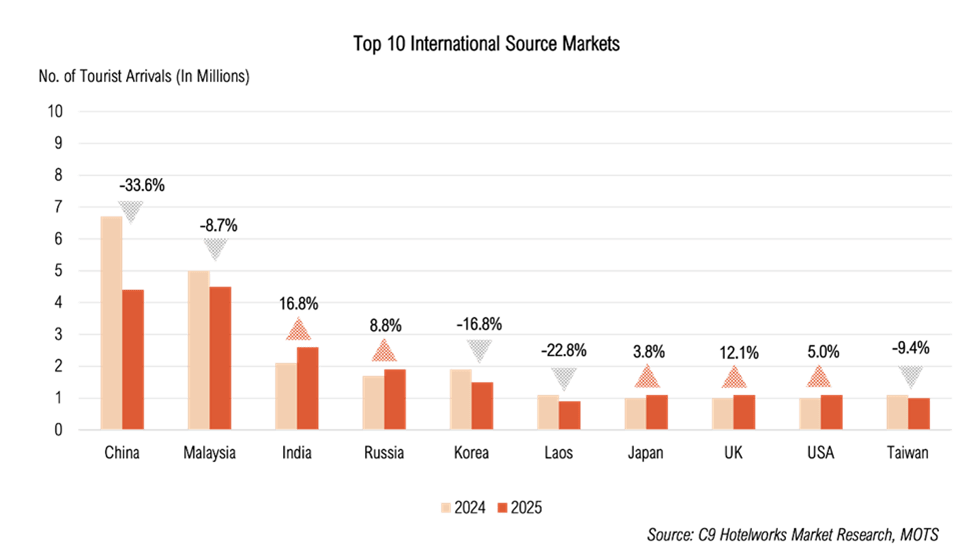
Thailand remains a diversified tourism market. Thailand recorded approximately 33.0 million international arrivals in 2025, with total tourism revenue reaching THB2.9 trillion. While Chinese arrivals remain below historical levels, demand diversification across Malaysia, India, Russia, the UK, and the US has strengthened resilience. According to the Tourism Authority of Thailand (TAT), international arrivals are projected at approximately 35 million in 2026, reflecting continued government-led tourism initiatives and sustained destination confidence.
Hotel performance is dispersing across regional markets
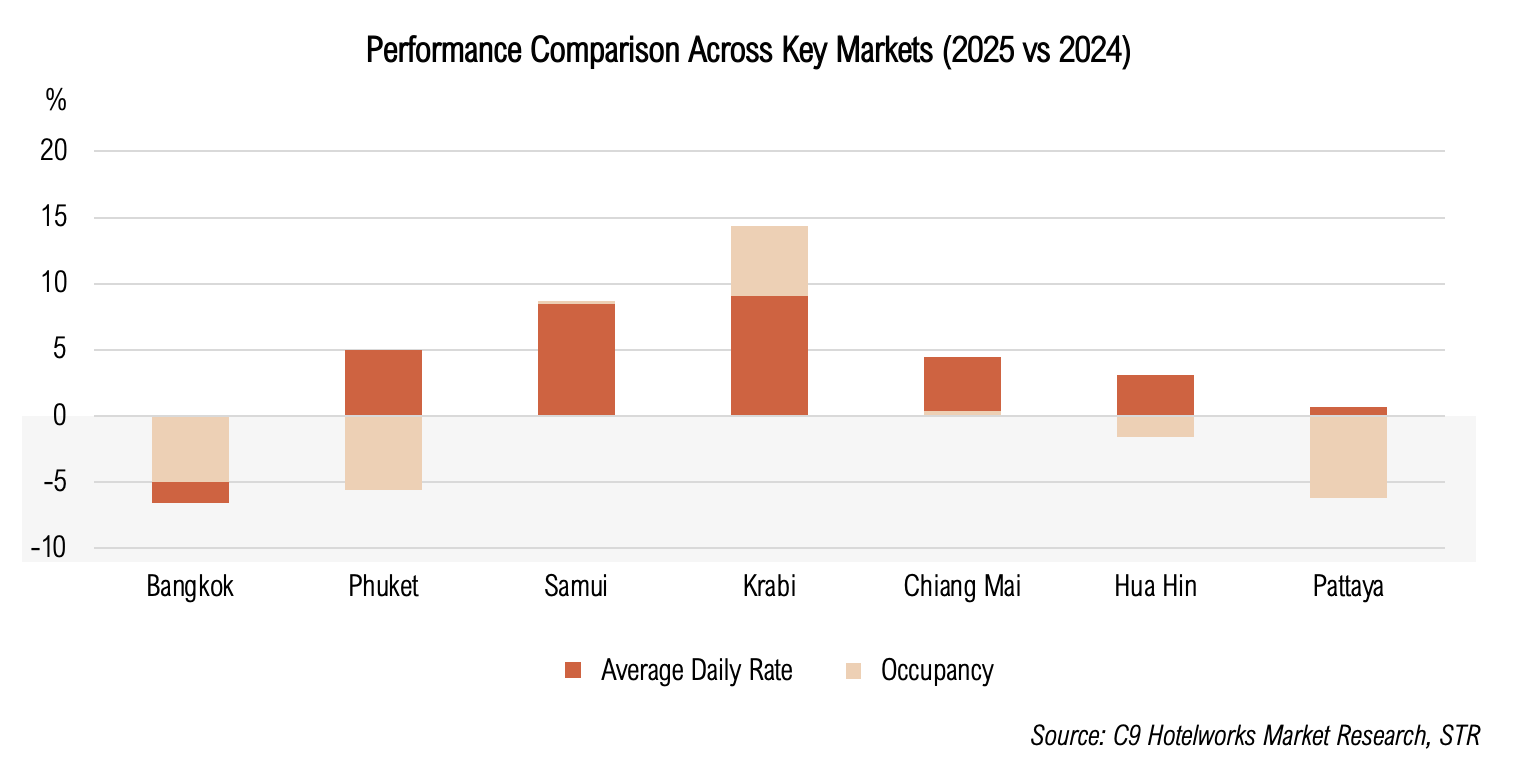
Hotel performance in 2025 displayed increasing dispersion across Thai markets, reflecting differences in demand composition, airlift exposure, and domestic reliance. At the regional level, the South recorded marginal occupancy growth of 0.3% year-on-year, while ADR increased by 20.4%, indicating strong rate expansion in resort-driven markets such as Phuket, Samui, and Krabi. In contrast, the Central and North regions experienced a 4.6% decline in occupancy, while ADR grew by 5.6%.
Hotel performance in 2025 displayed increasing dispersion across Thai markets, reflecting differences in demand composition, airlift exposure, and domestic reliance. At the regional level, the South recorded marginal occupancy growth of 0.3% year-on-year, while ADR increased by 20.4%, indicating strong rate expansion in resort-driven markets such as Phuket, Samui, and Krabi. In contrast, the Central and North regions experienced a 4.6% decline in occupancy, while ADR grew by 5.6%.
Emerging destinations' trajectory is tied to infrastructure delivery.
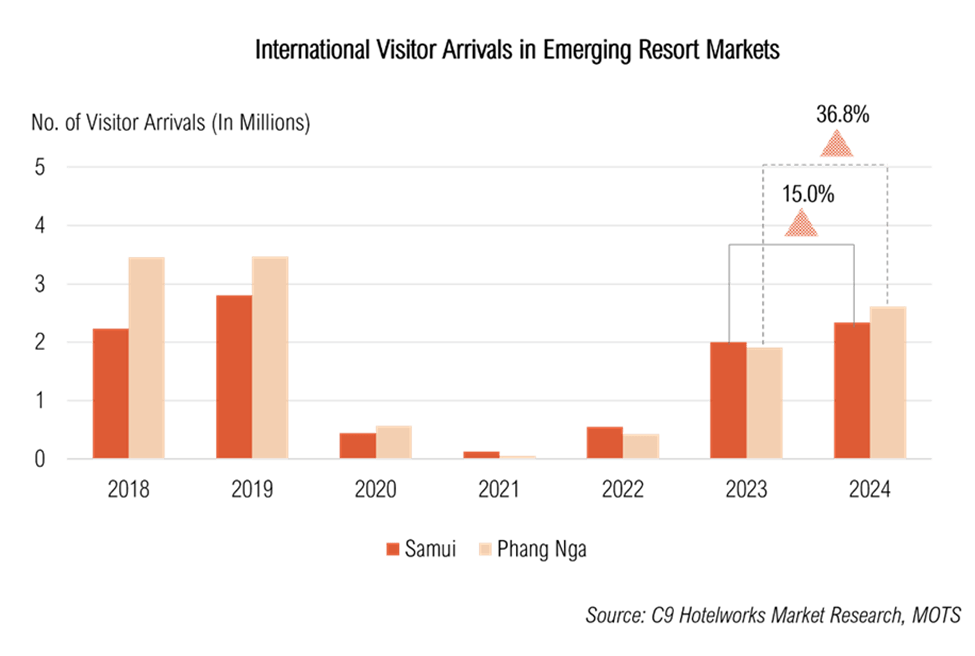
Emerging destinations, including Koh Samui and Phang Nga, recorded simultaneous growth in visitor arrivals and hotel performance indicators. The forward trajectory of these markets remains closely tied to infrastructure delivery, notably the proposed Koh Samui Expressway Project and the planned Andaman International Airport in Khok Kloi, Phang Nga. If executed, these projects would materially expand international accessibility and reshape long-term demand capacity in the Andaman corridor.
Emerging destinations, including Koh Samui and Phang Nga, recorded simultaneous growth in visitor arrivals and hotel performance indicators. The forward trajectory of these markets remains closely tied to infrastructure delivery, notably the proposed Koh Samui Expressway Project and the planned Andaman International Airport in Khok Kloi, Phang Nga. If executed, these projects would materially expand international accessibility and reshape long-term demand capacity in the Andaman corridor.
The hotel lending environment is active but disciplined.
Thailand's hotel lending environment remains active but disciplined. Lenders continue to emphasize developer track record, location quality, cash flow stability, sponsor strength, and conservative capital structures, with minimum DSCR thresholds typically at 1.2x for development and 1.4 to 1.5x for stabilized assets. Loan-to-value (LTV) ratios generally range between 50% and 60%, reflecting heightened underwriting discipline. Institutional liquidity remains focused on prime and well-positioned assets.
Thailand's hotel lending environment remains active but disciplined. Lenders continue to emphasize developer track record, location quality, cash flow stability, sponsor strength, and conservative capital structures, with minimum DSCR thresholds typically at 1.2x for development and 1.4 to 1.5x for stabilized assets. Loan-to-value (LTV) ratios generally range between 50% and 60%, reflecting heightened underwriting discipline. Institutional liquidity remains focused on prime and well-positioned assets.
Thailand offers a structured legal framework for hotel investment
From a legal perspective, Thailand offers a structured framework for hotel investment, including:
For foreign investors, BOI eligibility and ownership structuring remain critical determinants of project feasibility, financing access, and exit liquidity.
From a legal perspective, Thailand offers a structured framework for hotel investment, including:
- Board of Investment (BOI) incentives for eligible projects
- Foreign Business License (FBL) considerations
- Defined land tenure structures
- Clear regulatory processes for Hotel Business License and EIA compliance
- Established transaction structuring options (asset versus share deals)
For foreign investors, BOI eligibility and ownership structuring remain critical determinants of project feasibility, financing access, and exit liquidity.
Sustainability is now embedded in underwriting and capital allocation
Sustainability considerations are increasingly embedded within underwriting standards and institutional capital mandates. ESG alignment now functions as a risk-adjustment factor influencing financing access, margin pricing, and long-term liquidity.
Sustainability considerations are increasingly embedded within underwriting standards and institutional capital mandates. ESG alignment now functions as a risk-adjustment factor influencing financing access, margin pricing, and long-term liquidity.
Highlight Statistics
- 33 million international arrivals: Thailand's 2025 total international arrivals, supported by demand diversification across Malaysia, India, Russia, the UK, and the US.
- THB2.9 trillion tourism revenue: Thailand's 2025 total tourism revenue.
- 35 million projected arrivals: Tourism Authority of Thailand's projection for 2026, reflecting continued government-led tourism initiatives and sustained destination confidence.
- South: +20.4% ADR / +0.3% occupancy: resort-driven regional performance in 2025, led by Phuket, Samui, and Krabi.
- Central and North: +5.6% ADR / -4.6% occupancy: contrasting regional performance, evidence of widening dispersion across Thai markets.
Thailand's hospitality landscape is experiencing a pivotal market shift where cash flow resilience and precise operational control will dictate where capital flows. By marrying data-driven market performance with sophisticated joint venture and governance frameworks, the Thailand Hotel Investment Guide 2026 highlights that the key to unlocking sustainable yield in this adaptive platform depends not just on asset quality, but on strict compliance and strategic positioning. Download the full Thailand Hotel Investment Guide 2026 from C9 Hotelworks and Watson Farley & Williams at c9hotelworks.com.
About C9 Hotelworks
Founded in 2003 and headquartered in Phuket, Thailand, C9 Hotelworks is a hospitality consulting firm specializing in hotels, branded residences, real estate and mixed-use developments across the Asia Pacific, Indian Ocean, and African regions. The firm has delivered over 1,000 projects in 110 locations.