
Stefano Capaccetti and the All-Inclusive Hotel Revolution Redefining Phu Quoc’s Luxury Landscape
15.10.2026
3 Key Takeaways
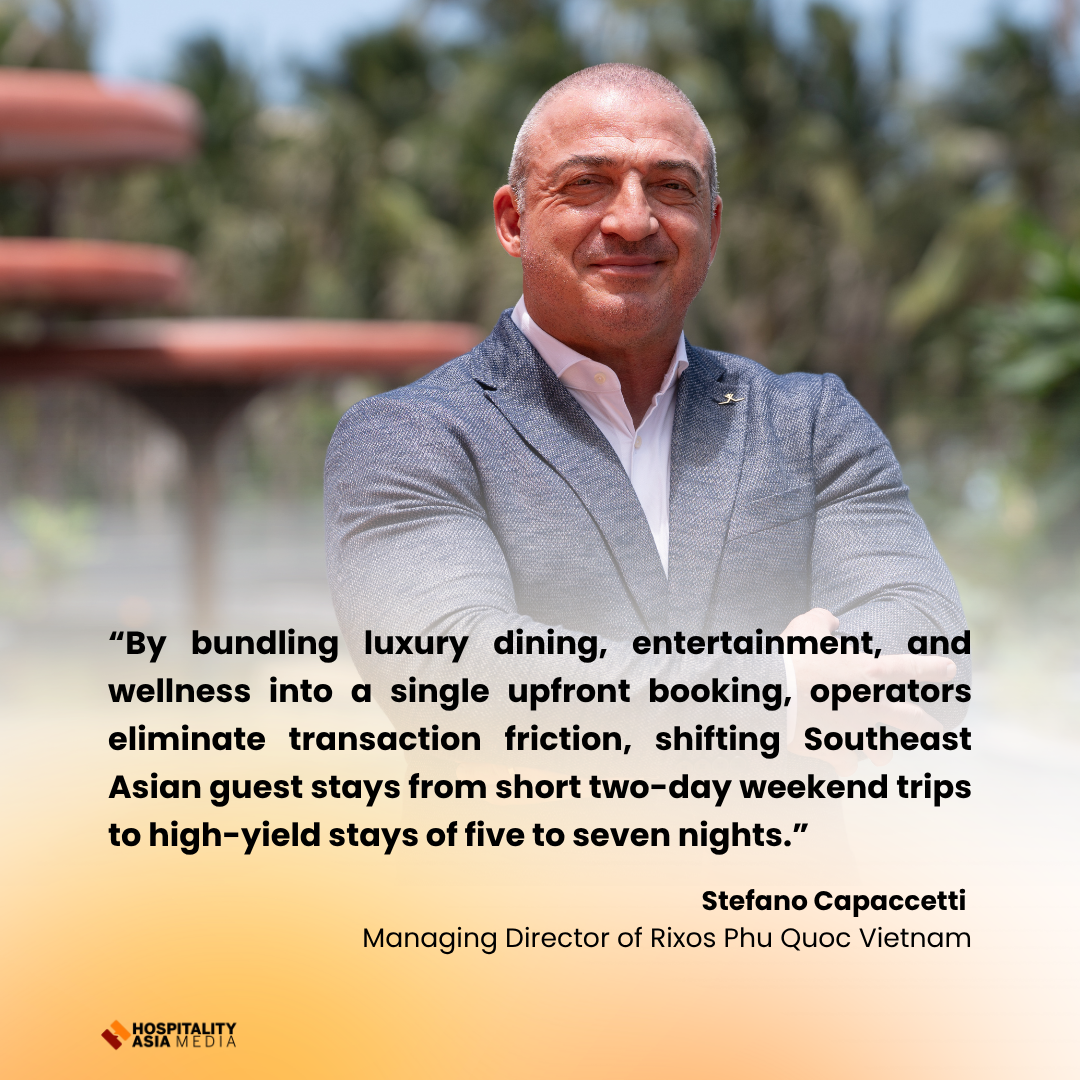
- The All-Inclusive Model Transforms Regional Travel Behavior: By bundling luxury dining, entertainment, and wellness into a single upfront booking, operators eliminate transaction friction, shifting Southeast Asian guest stays from short two-day weekend trips to high-yield stays of five to seven nights.
- Integrated Non-Rooms Assets Capture Revenue Density: Embedding world-class entertainment, 27 food and beverage outlets, and dedicated MICE facilities supports greater year-round commercial resilience.
- Island Logistics Require Specialized Infrastructure: Operating on remote offshore islands demands dedicated marine access fleets, cable car connectivity, and advanced safety protocols to ensure seamless supply chain logistics and guest transport.
The expansion of luxury hospitality across Southeast Asia has reached a pivotal structural milestone. As Vietnam accelerates its position as one of the region's most dynamic tourism engines, the island of Phu Quoc has evolved from a quiet coastal destination into a heavily invested resort hub. The debut of a major luxury all-inclusive resort on Hon Thom Island marks a significant shift in how large-scale assets capture, service, and retain international travelers.
In this exclusive conversation with Hospitality Asia Media, Managing Director of Rixos Phu Quoc Vietnam, Stefano Capaccetti draws upon 35 years of global executive experience across 13 countries to break down the operational economics of island hospitality, the strategic deployment of non-rooms revenue anchors, and the long-term master planning driving Phu Quoc's competitive transformation.
Q: You have spent 35 years in hospitality across 13 countries. What brought you to Vietnam to lead this landmark island development?
Stefano Capaccetti: My career in hospitality began at the foundational level. Over the past 35 years, I have worked across every major hotel department, transitioning from food and beverage into sales, marketing, revenue management, and overall operational execution. Over the last two decades, my focus has centered on pre-opening management for complex, large-scale luxury properties and mixed-use developments that integrate hotel keys with retail corridors, wellness hubs, and theme parks.
My journey with Rixos began 17 years ago, well before its strategic joint venture with Accor. My leadership postings have taken me through Kazakhstan, followed by executive assignments in Turkey, Switzerland, Italy, France, Russia, Dubai, Abu Dhabi, and Qatar. Vietnam marks the 13th country where I have lived and operated.
My core objective in any market is taking our brand's foundational DNA, rooted in Turkish hospitality and our All-Inclusive, All-Exclusive approach,, and tailoring it seamlessly to the host country. On a personal level, I am an active technical diver, so relocating to an island environment like Phu Quoc aligns perfectly with my personal passions. Professionally, Vietnam is opening up to the global travel market at an extraordinary pace, making Hon Thom Island one of the most exciting development frontiers in Asia.
Q: Phu Quoc’s tourism infrastructure has expanded rapidly in recent years. How does its commercial landscape compare to more mature regional resort markets like Bali or Phuket?
Stefano Capaccetti: The acceleration of Phu Quoc's tourism infrastructure over the last five years is remarkable. When I last visited the island in 2020, the master plan was in its early stages. Returning today reveals a transformed destination supported by massive capital investments, including airport expansion projects and dedicated air services designed to handle high-density international passenger volume.
While established markets like Bali and Phuket are dealing with product saturation in primary corridors, Phu Quoc offers a fresh canvas. We recognized a major strategic gap: the true luxury all-inclusive model remains largely unpenetrated across Southeast Asia compared to established markets in the Mediterranean or the Caribbean.
Q: Why is Phu Quoc the right environment to launch a luxury all-inclusive resort, and how does that model change guest booking behavior?
Stefano Capaccetti: Our approach to all-inclusive hospitality focuses on complete friction-free personalization. The experience brings together fine dining, premium beverages, family activities, water sports and wellness within the all-inclusive offering.. For families and long-haul travelers, eliminating on-property transaction anxiety is a powerful value proposition.
This model appeals directly to high-net-worth feeder markets across Central Europe, the Middle East, and CIS regions seeking warm-weather escapes during winter months. Furthermore, by embedding authentic local Vietnamese culinary and cultural programming throughout the resort, we successfully shift regional travel behavior: instead of capturing standard two-night weekend stays, we are seeing potential for longer five-to-seven-night stays.
Merging Non-Rooms Revenue Anchors with Island Infrastructure
Q: All-inclusive resort models rely heavily on high guest retention within the property footprint. How do you design entertainment and wellness ecosystems that keep guests engaged throughout their stay?
Stefano Capaccetti: Guest retention is achieved when a resort ecosystem is so rich and varied that visitors feel zero motivation to leave the property footprint.
From an entertainment perspective, Phu Quoc is positioning itself as a regional cultural hub, contracting world-class international shows and performances. Within our resort footprint, we build structured, multi-tiered activity schedules. This includes professional sports academies, CrossFit and yoga sessions led by international experts, dedicated kids' robotics and craft labs, and curated adult evening entertainment.
In terms of wellness, Vietnam is naturally positioned as an international wellness destination. We approach wellness far beyond the traditional spa building, integrating sensory aromatherapy, curated nutritional menus, dedicated meditation spaces, and active ocean sports into the guest's daily itinerary. We position the asset as a luxury family resort that incorporates wellness as a core operational pillar.
Q: How do you integrate local food and beverage concepts into an all-inclusive framework to drive revenue density and deliver an authentic sense of place?
Stefano Capaccetti: Local culinary authenticity provides our strongest competitive anchor. Alongside our Turkish and Mediterranean heritage concepts, we operate dedicated local venues, including Velena, an upscale Vietnamese food court concept that delivers immersive dining from indoor-outdoor cooking stations to grab-and-go options.
Hyper-local touches, such as welcome amenities featuring famous Phu Quoc black pepper and regional mangoes, ensure that guest touchpoints are tied directly to Vietnamese heritage. When entertainment, wellness, and food and beverage function as an integrated ecosystem, guest satisfaction rises and multi-night stay extensions become automatic.
Q: Operating on an offshore island introduces distinct operational challenges. How are you managing supply chain logistics, staff housing, and marine infrastructure?
Stefano Capaccetti: Operating an offshore island asset requires the operational rigor of a Maldives resort. Safety, emergency response protocols, and marine supply logistics must be integrated into daily asset management.
Guest and staff transit to Hon Thom Island features a landmark asset: the World Guiness Record 7.9-kilometer continuous three-wire cable car system.Regarding human capital, Vietnam possesses a talented, service-oriented workforce. The operational key for an island property is selecting team members who adapt well to island living. As destination development continues, the addition of international schooling, healthcare, and residential infrastructure will further strengthen our ability to attract and retain top-tier international talent.
Q: Beyond leisure travel, how does your asset capture corporate and MICE business to balance seasonal leisure demand?
Stefano Capaccetti: MICE is a major growth pillar that Phu Quoc previously lacked at scale. To capture this market, we are opening a dedicated three-story event facility featuring a grand ballroom capable of hosting up to 1,500 delegates. This infrastructure will be fully operational ahead of major global events like APEC 2027. We are already seeing strong advance booking inquiries for large corporate retreats, incentive trips, and international galas from Middle Eastern and European corporate markets, providing a reliable yield baseline that balances seasonal leisure fluctuations.
Commercial Resilience & The Five-Year Regional Vision
Q: Managing seasonality is a major challenge for island resorts in Southeast Asia. How do you protect rate integrity and maintain operational yield during shoulder periods?
Stefano Capaccetti: Seasonality is managed through dynamic market diversification. During regional shoulder months between April and September, our commercial strategy pivots toward secondary Asian feeder markets with stable year-round outbound travel, such as South Korea and the Philippines. During these periods, we adjust rate tiers dynamically and transition our activity programming smoothly from open-air beach venues to indoor entertainment complexes, specialized wellness retreats, and culinary masterclasses.
Q: Looking at the long-term horizon, what is your outlook for Phu Quoc’s growth, and what are the next strategic milestones for the brand in the region?
Stefano Capaccetti: Looking at the five-year horizon, Phu Quoc's tourism growth story is just beginning. Backed by transformative infrastructure investments, including international hospital developments, expanded airport capacity competing with regional transit hubs, and developer-backed air fleets operating up to 36 flights daily during peak periods, southern Phu Quoc is establishing itself as a top-tier luxury destination in Asia.
Our immediate focus is finalizing our initial launch phase of under 500 room keys, scaling toward full multi-phase operational capacity. Looking broader, we continue to explore opportunities across Vietnam and Southeast Asia. By executing an uncompromising luxury all-inclusive model anchored in local culture, we are building sustainable asset value and establishing a new benchmark for resort hospitality across the region.
About Stefano Capaccetti
Stefano Capaccetti is the Managing Director of Rixos Phu Quoc, leading the brand's flagship entry into Southeast Asia. Spanning 35 years of international hospitality experience across 13 countries in Europe, the Middle East, Central Asia, and Asia-Pacific, Capaccetti specializes in large-scale luxury resort openings, mixed-use entertainment developments, and strategic asset management. He previously held senior executive leadership roles across Rixos properties in Qatar, the UAE, Turkey, and Kazakhstan.