
Santiago Sagaz Navigating Ultra-Luxury Hospitality, Cultural Authenticity, and Sustainable Profitability in Bali
05.11.2026
Key Takeaways
- Location-Driven Commercial Differentiation: Positioned in the rainforest highlands of Payangan, Anantara Ubud leverages its serene geographic niche to capture travelers seeking slow living and authentic culture, protecting premium pricing and extending average length of stay rather than competing on price alone.
- Total Revenue Optimization (TRevPAR): Through a curated ecosystem of Mediterranean and regional culinary concepts, indigenous wellness retreats, and pre-arrival personalized packaging, the resort transforms non-room touchpoints into high-yielding, independent profit centers.
- Hyper-Personalization as the Core Differentiator: While physical luxury hardware can be easily replicated, customized service rooted in guest intelligence and delivered with unscripted human warmth unlocks higher willingness-to-pay, direct booking conversion, and long-term brand loyalty.
The ultra-luxury hospitality landscape is undergoing a profound structural evolution. Modern affluent travelers no longer measure luxury merely by opulent hardware, extravagant design, or standardized service protocols. Instead, today’s luxury consumers increasingly prioritize time, privacy, hyper-personalization, and an authentic emotional connection to the destination. In high-density, highly competitive resort markets like Bali, luxury hoteliers face a complex dual challenge: delivering deeply intuitive, high-touch guest experiences while maintaining rigorous commercial discipline, premium rate integrity, and sustainable margin growth.
At the forefront of navigating this dynamic landscape in Indonesia is Santiago Sagaz, General Manager of Anantara Ubud Bali Resort. Positioned in the quiet, forested highlands of Payangan, north of Ubud, Santiago leads a strategic operational model that balances global brand standards with Balinese heritage, total revenue engineering, and long-term asset value creation.
At the forefront of navigating this dynamic landscape in Indonesia is Santiago Sagaz, General Manager of Anantara Ubud Bali Resort. Positioned in the quiet, forested highlands of Payangan, north of Ubud, Santiago leads a strategic operational model that balances global brand standards with Balinese heritage, total revenue engineering, and long-term asset value creation.
Market Dynamics & Global-Local Brand Harmonisation
Q: Bali remains one of the most competitive and densely supplied luxury resort markets in Asia. How do you assess the current state of Bali’s luxury sector?
Santiago Sagaz: Bali remains one of the world’s most compelling luxury destinations, but it is also increasingly competitive. The opportunity lies in the island’s ability to offer much more than traditional resort luxury. Travelers are looking for wellness, gastronomy, culture, nature, and meaningful experiences. The challenge is differentiation. As supply grows, properties need a clear sense of place and a reason for guests to choose them beyond the physical product.
Q: Anantara is globally recognized for weaving indigenous culture into its luxury narrative, yet Bali’s hotel market is deeply rooted in local Balinese spiritual and architectural traditions. How do you integrate global brand operational standards without diluting local cultural authenticity or making the guest journey feel pre-packaged?
Santiago Sagaz: Anantara’s philosophy has always been deeply connected to destination, so Bali is a natural expression of the brand. At Anantara Ubud Bali Resort, our role is not to manufacture Balinese culture for guests but to create respectful opportunities for them to encounter it.
This can happen through food, wellness, ceremonies, local journeys, and interactions with our Balinese team and surrounding communities. Experiences such as our Sandikala ritual, traditional wellness practices, and journeys into the landscapes and villages around Payangan allow culture to remain part of everyday life rather than becoming a performance created purely for tourism. Global standards give us consistency, but the personality of the resort must come from the place and its people.
Revenue Stream Engineering, TRevPAR & Yield Maximisation
Q: What is your commercial roadmap for maximizing non-rooms revenue across dining, wellness, and private excursions to elevate Total Revenue Per Available Room (TRevPAR)?
Santiago Sagaz: A luxury resort should look beyond rooms as the primary revenue driver. The guest journey creates opportunities across dining, wellness, recreation, culture, and curated destination experiences. The key is relevance rather than simply offering more. By understanding each guest’s interests and introducing the right experiences from pre-arrival throughout their stay, we can enrich their time with us while naturally increasing non-room revenue and overall TRevPAR.
Q: The wellness sector in Ubud is highly competitive, with travelers seeking everything from traditional healing to modern recovery. How do you structure spa programming, multi-day wellness retreats, and indigenous therapies to transform the spa from an amenity into a high-yielding, independent profit center?
Santiago Sagaz: Wellness is rooted in the traditions and natural surroundings of Bali. Alongside Anantara Spa treatments, our signature experiences draw on local healing practices, from Taksu Massage and Usadha Kitri to Vajra Gita meditation, sound healing, and traditional purification journeys. The natural environment of Payangan further allows us to connect wellbeing with nature, culture, and mindful movement.
Our approach is to make wellness part of the guest journey rather than an isolated appointment. By personalizing experiences around individual needs and length of stay, we can create a deeper sense of connection and renewal, while positioning wellness as an integral part of the Anantara Ubud experience.
Q: In hyper-competitive micro-markets like Ubud, new luxury properties often face pressure to lower rates to build volume. What commercial strategies do you deploy to defend your Average Daily Rate (ADR) and rate integrity during seasonal demand drops?
Santiago Sagaz: Rate integrity begins with having a clear value proposition. Discounting may generate short-term volume, but it cannot replace differentiation. Our priority is therefore to strengthen the reasons guests choose Anantara Ubud Bali Resort: the rainforest setting of Payangan, spacious accommodation and private pool villas, personalized service, wellness, distinctive dining, and access to authentic local experiences.
During softer periods, I prefer creating additional value through experiences, length-of-stay benefits, or thoughtful packages rather than relying solely on price reductions. This helps protect the positioning of the resort while giving guests a stronger reason to stay longer and experience more.
Q: How do you optimize inventory allocation, upselling pathways, and pre-arrival packaging to maximize yields across different room tiers?
Santiago Sagaz: Different accommodation categories serve different guest needs, so they should not all be sold in the same way. The opportunity is to understand the purpose of the trip early, whether it is a honeymoon, wellness escape, family journey, or longer leisure stay, and then recommend the accommodation and experiences that best suit that guest. Pre-arrival communication is particularly important because it allows us to personalize the experience and create relevant upgrade opportunities before the guest reaches the resort.
Macro Financial Strategy, GOP Engineering & Asset Resilience in Emerging Micro-Markets
Q: What flexible budgeting frameworks and operational cost-structure models must hoteliers build to protect Gross Operating Profit (GOP) during seasonal volume swings?
Santiago Sagaz: Luxury resorts need financial discipline, but cost management should never become visible to the guest. The most effective approach is flexible planning, strong forecasting, and close collaboration between operations, finance, and commercial teams. Labor, procurement, and operating resources need to respond intelligently to demand without compromising the standards that define the brand.
I also believe profitability should be considered over the long term. Investing in people, preventative maintenance, sustainability, and guest experience can protect the asset and reduce much larger costs later.
Q: How do experienced hospitality leaders navigate these competing priorities to ensure long-term Net Operating Income (NOI) growth without degrading brand value?
Santiago Sagaz: A General Manager has a responsibility to create alignment between ownership objectives, brand standards, and operational reality. These interests are not necessarily in conflict. Owners need sustainable returns, brands need to protect long-term equity, and guests expect the experience they were promised. Strong communication and transparent decision-making help ensure that commercial objectives do not undermine the product or brand.
The healthiest results come when decisions are evaluated not only by their immediate financial impact but also by what they mean for the asset, the team, the guest, and the long-term positioning of the resort.
Q: What macro framework can luxury hoteliers deploy to convert price-sensitive OTA bookers into loyal direct guests, and how can properties build direct-channel booking power without damaging their crucial distribution partnerships with OTAs?
Santiago Sagaz: OTAs remain valuable partners because they provide global visibility and access to travelers who may not yet know the brand. I do not see the relationship simply as OTA versus direct. The opportunity begins once a guest discovers us. Our own channels need to communicate clearly why Anantara Ubud Bali Resort and Payangan are distinctive and give guests confidence to engage directly with the resort.
Once guests stay with us, personalization, recognition, and loyalty become increasingly important. A memorable first stay can create a direct relationship for future visits without diminishing the important role distribution partners play in acquiring new guests.
Macro Hyper-Personalisation Strategies & Guest Experience Engineering in Saturated Markets
Q: In hyper-competitive luxury resort markets where premium physical hardware is easily replicated by competitors, how does hyper-personalization become a property’s primary commercial differentiator, and how does customized service directly unlock higher Willingness-to-Pay and guest retention?
Santiago Sagaz: Physical luxury is increasingly easy to replicate. What is much harder to replicate is the feeling that an experience has been created specifically for you. Personalization can mean understanding why someone has traveled to Bali and then shaping their experience accordingly. One guest may want privacy and wellness, another may want to explore Balinese culture and nature, while another may travel primarily for gastronomy.
When guests feel understood, value is no longer measured only by the size of the villa or the facilities available. It is measured by relevance, emotional connection, and memories, and that is ultimately what builds loyalty.
Q: What is the secret to using guest intelligence behind the scenes while empowering frontline teams to deliver warm, spontaneous, and unscripted human touchpoints?
Santiago Sagaz: Technology should inform hospitality, not replace it. Guest information can help us understand preferences, previous stays, and important occasions, but the final interaction should feel human. Our teams need enough information to anticipate needs while also having the confidence and freedom to respond naturally.
The strongest luxury service often comes from small moments that were never scripted. Our role as leaders is to provide the team with the knowledge and empowerment to create those moments.
Q: What is the operational framework required to curate bespoke local experiences, such as private hinterland tours or indigenous wellness rituals, so that they feel genuinely organic, unique, and deeply authentic for every individual guest every single time?
Santiago Sagaz: Authenticity requires relationships. You cannot create meaningful local experiences simply by writing an itinerary. Being in Payangan gives Anantara Ubud Bali Resort access to landscapes, villages, traditions, and communities beyond Bali’s more established tourism routes. Experiences should therefore be developed with local knowledge and respect for the people and environments involved.
Q: How can luxury hoteliers strategically structure tailored pre-arrival packaging, bespoke dining experiences, and customized wellness journeys to drive high-margin ancillary spending across the property?
Santiago Sagaz: Personalization becomes commercially powerful when it begins before arrival.
If we understand whether guests are traveling for romance, wellbeing, food, culture, or family time, we can curate relevant experiences rather than presenting everyone with the same list of activities.
At Anantara Ubud Bali Resort, this could mean a personalized wellness journey at Anantara Spa, private dining surrounded by nature, an Indonesian culinary experience at Kirana, a Mediterranean dinner at Amerta, or an exploration of Payangan village, Alas Taro, and its surrounding landscapes by vintage sidecar or Jeep.
The commercial value follows naturally when the recommendation genuinely enhances the guest’s stay.
Q: Having managed luxury resort operations across international borders, what single operational standard do you believe will define the next era of profitable, sustainable luxury in Bali?
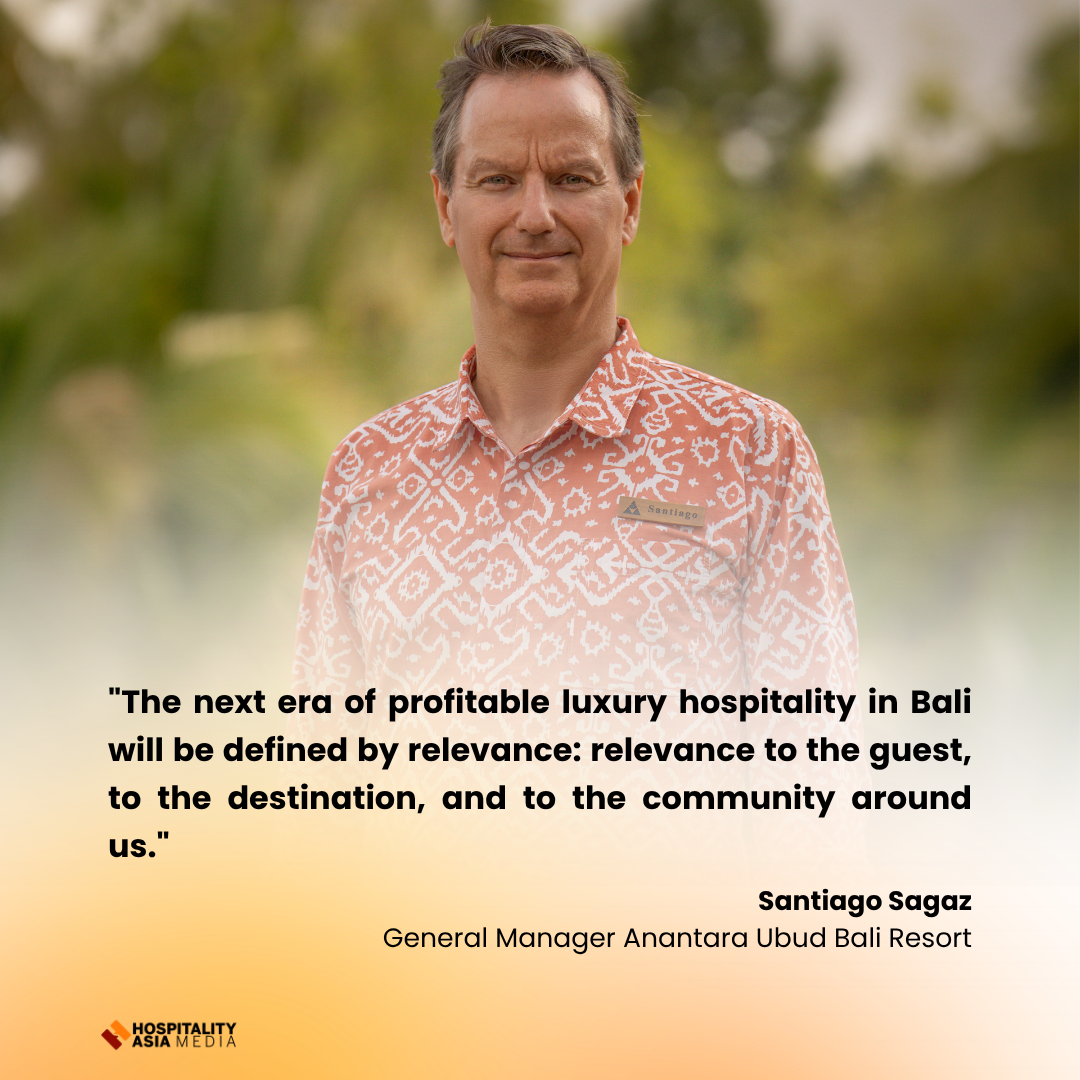
Santiago Sagaz: I believe the next era of profitable luxury hospitality in Bali will be defined by relevance: relevance to the guest, to the destination, and to the community around us.
Bali does not need more hotels that could exist anywhere in the world. Luxury resorts in Bali need to understand what makes their particular location meaningful and protect that sense of place as they grow commercially.
At Anantara Ubud Bali Resort, my ambition is to establish the resort as a distinctive luxury destination in Payangan, north of Ubud, known not only for its rainforest setting and private pool villas, but for meaningful wellness, dining, Balinese culture, and local experiences delivered with genuine human warmth.
If we can build strong commercial performance while creating opportunities for our people, respecting the destination, and giving guests a deeper connection to Bali, that is a legacy worth building.
About Santiago Sagaz
Santiago Sagaz is an accomplished international hospitality leader currently serving as the General Manager of Anantara Ubud Bali Resort. Known for his culturally empathetic, adaptive, and empowerment-driven leadership style, Santiago oversees the operational and strategic direction of Anantara Ubud Bali Resort in Payangan, north of Ubud. Under his leadership, the resort executed a holistic operational model that seamlessly integrated global luxury standards with authentic Balinese heritage, total revenue engineering, and sustainable asset performance.