

Domestic tourism acts as the ultimate economic safety net across Southeast Asia’s major economies in 2026. While intra-regional travel and international source markets navigate intense marketing wars, fluctuating airfares, and currency shifts, millions of local travelers are pivoting toward domestic secondary cities, providing a resilient baseline for hospitality operators and transport networks.
This article details the distinct 2026 performance profiles of Indonesia, Malaysia, Thailand, Vietnam, and the Philippines, tracking domestic mobility against intra-ASEAN and long-haul international arrivals.
This article details the distinct 2026 performance profiles of Indonesia, Malaysia, Thailand, Vietnam, and the Philippines, tracking domestic mobility against intra-ASEAN and long-haul international arrivals.
Country-by-Country Performance Profiles

Indonesia: High-Volume Domestic Shielding
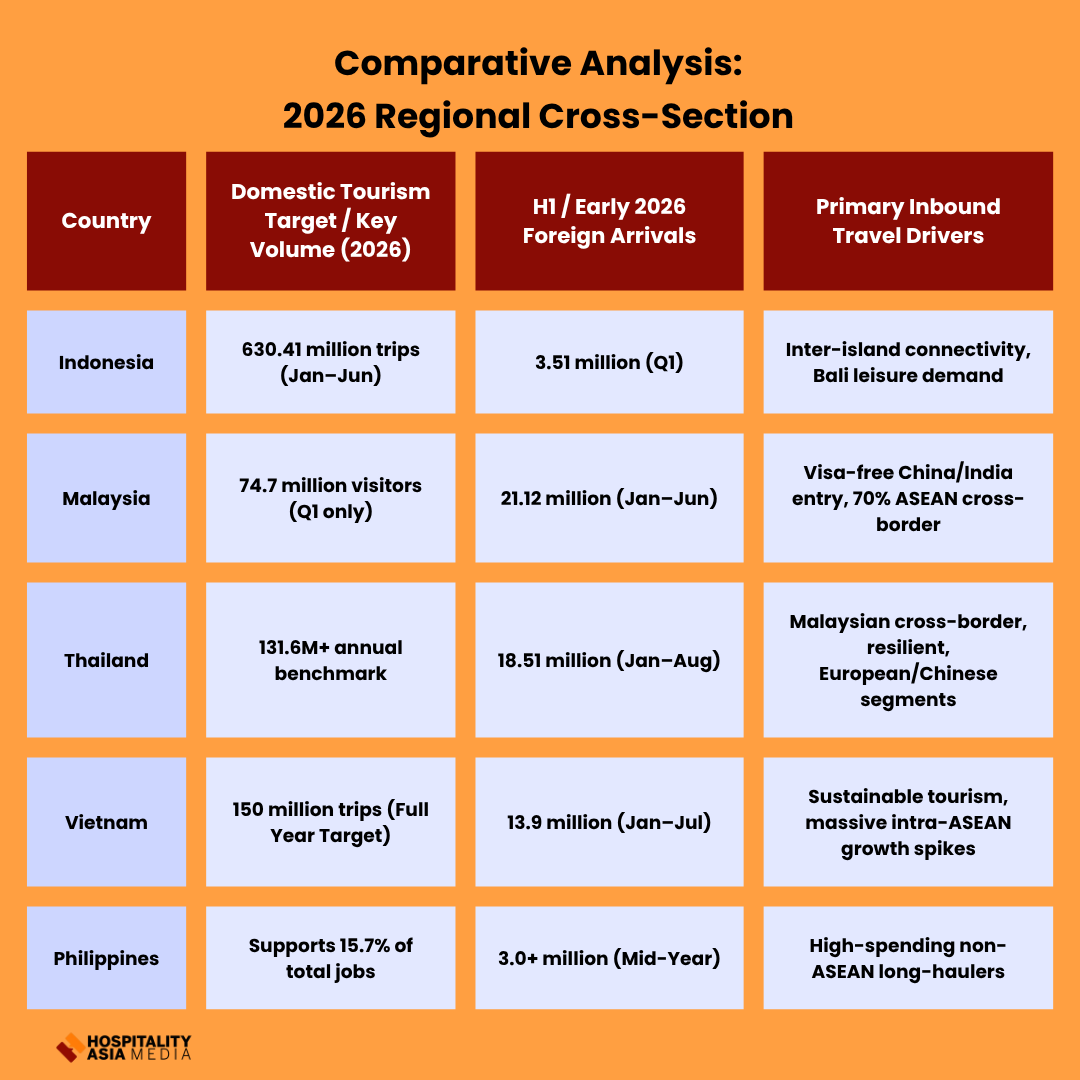
- Domestic Travel: Indonesia leads the region in absolute domestic volume. The archipelago logged 630.41 million domestic tourist trips in the first half of 2026 alone according to Statistics Indonesia (BPS). Growth has been sustained by affordable inter-island air capacity and deeply ingrained cultural travel habits.
- Intra-ASEAN Market: Short-haul regional travel serves as a vital operational baseline, though it remains price-sensitive. Volatility in regional flight pricing periodically redirects price-conscious regional travelers toward competitive package deals in neighboring hubs like Malaysia or Singapore.
- International (Non-ASEAN): Foreign visitor arrivals reached 7.45 million in the first half of 2026, with non-ASEAN long-haul leisure travel anchored primarily around Bali and key eco-tourism corridors.

Malaysia: Regional Intra-ASEAN Powerhouse
- Domestic Travel: Malaysia achieved an explosive start to the year, with the Department of Statistics Malaysia (DOSM) reporting 74.7 million domestic visitors in Q1 2026 alone. Domestic tourism expenditure jumped 15.8% year-on-year to a record RM34.0 billion ($7.6 billion), driven by festive holiday overlaps including Chinese New Year and Aidilfitri.
- Intra-ASEAN Market: Nearby ASEAN markets remain Malaysia's primary growth driver, accounting for 72.8% of total international arrivals. Singapore leads as the single largest source market, complemented by sustained inbound volumes from Indonesia and Thailand.
- International (Non-ASEAN): According to the Ministry of Tourism, Arts and Culture (MOTAC), Malaysia welcomed 21.12 million international visitors in H1 2026. This market leadership is supported by expanded visa-free access for major non-ASEAN markets, including China and India.

Thailand: Transitioning Source Market Dynamics
- Domestic Travel: Thailand continues its steady post-pandemic domestic expansion, expanding beyond the 131.6 million overnight domestic trips recorded in previous years. State-backed promotion of secondary provinces has successfully redistributed tourist spend away from saturated urban cores.
- Intra-ASEAN Market: The kingdom relies heavily on cross-border short-haul travelers. Neighboring Malaysia has solidified its position as Thailand’s top overall foreign source market, temporarily outpacing arrivals from mainland China.
- International (Non-ASEAN): Figures from the Ministry of Tourism and Sports show Thailand recorded 18.51 million international arrivals through August 2026. Inbound non-ASEAN volume remains anchored by China (2.86 million arrivals), alongside steady long-haul inflows from India and Russia.

Vietnam: Accelerated Market Share Acquisition
- Domestic Travel: The Vietnam National Authority of Tourism (VNAT) has targeted 150 million domestic trips for the full year 2026. Spending habits among domestic travelers are increasingly shifting toward experiential, nature-based travel, such as eco-trekking in Ha Giang and cultural heritage workshops in Central Vietnam.
- Intra-ASEAN Market: Inbound regional arrivals are surging, highlighted by double-digit growth from the Philippines (+63.6%), Cambodia, Singapore, and Indonesia. Expanded regional flight connections and flexible short-haul routes have accelerated this shift.
- International (Non-ASEAN): Official data from the National Statistics Office reveals Vietnam welcomed 13.9 million international visitors in the first seven months of 2026—a 13.8% year-on-year surge. European market arrivals surged 53.4%, tracking toward Vietnam's full-year target of 25 million foreign visitors.

Philippines: High Yields Amid Measured Footprints
- Domestic Travel: Domestic tourism serves as the structural backbone of the national travel economy. Data from the Philippine Statistics Authority (PSA) indicates that tourism-related employment supports 7.70 million local workers, accounting for 15.7% of total nationwide employment.
- Intra-ASEAN Market: The archipelago's geographic position creates unique logistics relative to mainland ASEAN hubs. Regional arrivals remain steady but face higher transit friction compared to border-connected land routes in Indochina.
- International (Non-ASEAN): The Department of Tourism (DOT) is pacing toward a revised target of 6.7 million international arrivals for 2026. While total arrival numbers are lower than neighboring Thailand or Malaysia, high-spending, long-haul international travelers generate a substantial multi-billion dollar contribution to national GDP.
Strategic Synthesis: Regional Dynamics
The Domestic Floor
Across all five nations, domestic mobility outpaces foreign arrivals by an astronomical margin. Faced with global inflationary pressures and elevated international airfares, regional consumers are substituting long-haul travel with domestic trips. This pivot provides predictable occupancy and steady cash flow for provincial hotel operators and transportation networks.
Intra-ASEAN Synergy
Shared land borders and short flight times define tourism performance in Malaysia, Thailand, and Singapore. Malaysia’s record performance demonstrates the value of seamless border connectivity and cross-border marketing campaigns. Vietnam is applying a similar model by leveraging targeted visa waivers to convert short-haul regional demand.
The High-Yield Long-Haul Segment
While non-ASEAN source markets (Europe, North America, and East Asia) require larger marketing investments and flexible visa policies, they deliver higher average spend per trip. Destinations like the Philippines, Bali, and Vietnam's coastal bio-reserves demonstrate that capturing high-spending long-haul travelers can generate significant macroeconomic yield, even when absolute visitor counts are lower.
As Southeast Asia navigates the remainder of 2026, the region's tourism sector illustrates a vital dual-track strategy. Domestic travel serves as an unbeatable economic buffer that stabilizes regional economies against global volatility. At the same time, targeted visa policies, intra-regional flight connectivity, and high-yield international campaigns remain essential to capturing high-value spend. Hospitality stakeholders and tourism policymakers who balance hyper-local domestic engagement with seamless cross-border travel will capture the most sustainable long-term yields in this dynamic marketplace.