
How Family Travel is Driving Indonesia’s Hospitality Real Estate Growth
21.09.2026
The landscape of Southeast Asian hospitality is undergoing a structural realignment. Once dominated by solitary backpackers and individual business travelers, regional tourism is now being shaped by the rise of family and multigenerational getaways.
Data from regional travel platforms highlights this shift: 69% of respondents in Indonesia prioritize family vacations over traveling with partners or friends. This positions Indonesia as the regional leader for family-first travel preference, comfortably pacing ahead of neighboring markets: Indonesia: 69% (Regional Leader), Vietnam: 61%, Malaysia: 59%, The Philippines: 55%.
This consumer behavior is driving double-digit expansion across Indonesia’s resort, accommodation, and leisure infrastructure, backed by rising domestic mobility and expanding international arrivals.
Key Tourism and Macro Growth Metrics
The macroeconomic tailwinds supporting Indonesia's family tourism expansion reflect strong momentum across both domestic travel corridors and international inbound markets:
- 7.45 Million Foreign Arrivals: International visitor arrivals reached 7.45 million, representing a 5.71% year-on-year increase and the highest H1 performance recorded since 2020.
- 630.41 Million Domestic Trips: Domestic tourist movements scaled past 630 million trips, marking a 2.71% rise compared to previous baselines.
- 13.14% Sector Growth: Indonesia’s accommodation and food/beverage service sector expanded by 13.14%, supported directly by high leisure occupancy during school holidays and long weekends.
- 10.92% Resort CAGR: The resort and spa sector is projected to compound at an annual growth rate of 10.92%, making it one of the fastest-growing asset classes within domestic real estate hospitality.
Segment 1: Mountain Escapes & Nature Resorts (West & East Java)
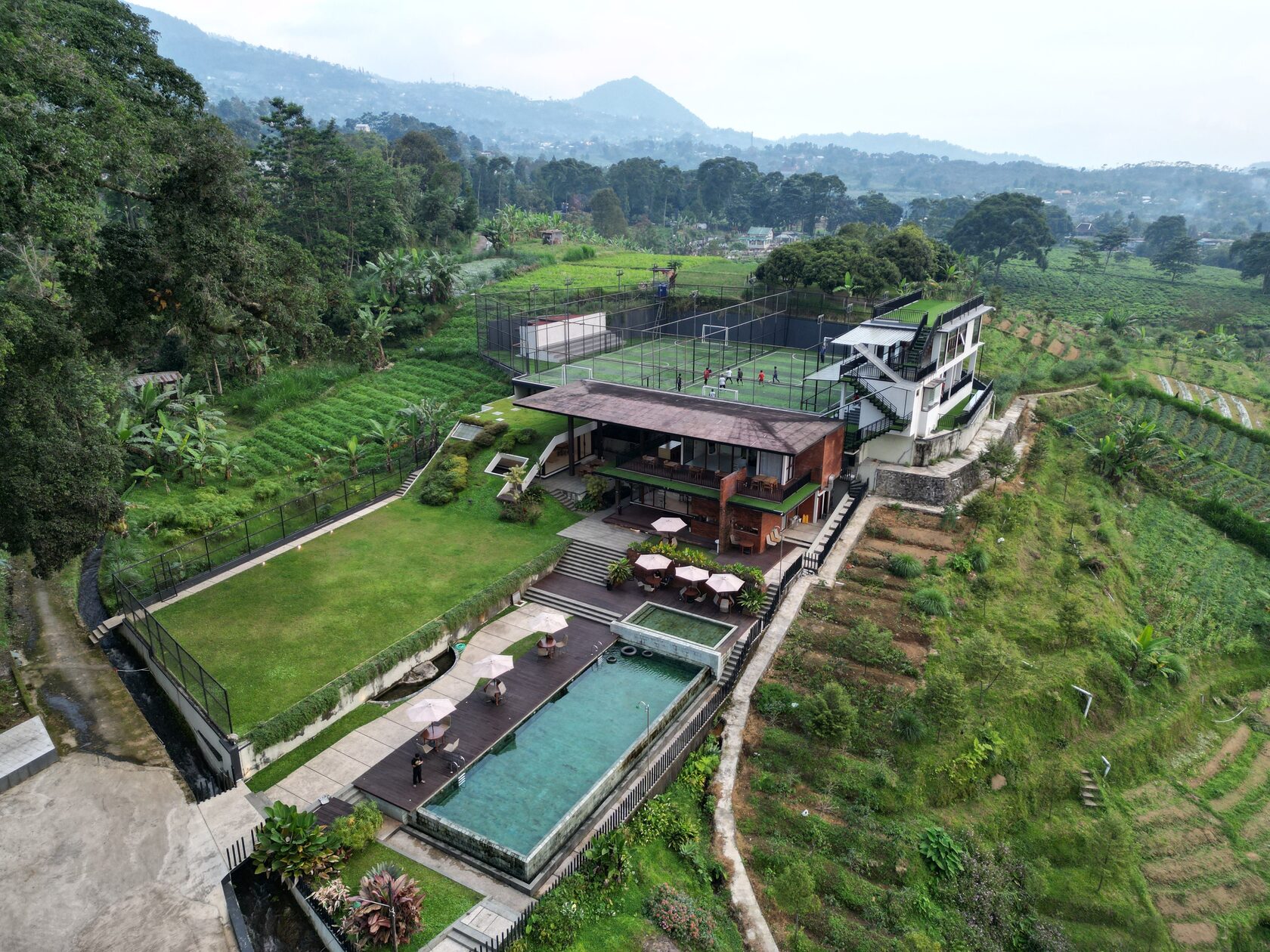
The domestic family travel market relies heavily on short-haul, high-frequency escapes originating from major urban hubs like Greater Jakarta (Jabodetabek) and Surabaya. Families seeking relief from coastal humidity and urban congestion are driving a major shift toward cool mountain climates and eco-lodges.
Puncak & Bogor Regency: The High-Velocity Weekend Corridor
Bogor Regency, anchored by the Puncak mountain pass—remains the premier weekend getaway destination for domestic urban families. Puncak recorded the highest search growth momentum in the nation, registering a +192% year-on-year surge in accommodation searches. West Java recorded over 18.86 million domestic tourist trips in a single month, demonstrating the sheer volume driving this mountain corridor.
Bandung & Malang: Agro-Tourism & Family Farms
Ranked #2 and #6 respectively on national domestic family destination leaderboards, Bandung and Malang are seeing high demand for alternative accommodations. Developers are expanding glamping compounds, treehouse cabins, and family resorts integrated with fruit orchards, volcano view trails, and farm-to-table culinary programming.
Segment 2: Multi-Generational Luxury (Bali & Lombok)
While Java drives high-frequency domestic trips, Bali and Lombok represent the dual engine where domestic capital meets high-yield international family spending.
Bali: The Global Leader in Luxury Family Stays
Voted the #1 multi-generational luxury travel destination globally, Bali blends high resort availability with seamless logistical infrastructure, such as accessible private group drivers costing roughly $100 per day for large family cohorts.
The island features 43 top-tier luxury family resorts offering multi-room villas designed for extended families under one roof. To balance the needs of children and grandparents, the island integrates 1,452 adult relaxation activities, ranging from cliffside wellness spas to coastal fine dining, alongside 235 dedicated children's attractions, including hands-on cooking schools, cultural crafting workshops, and marine conservation camps.
With 6.95 million direct foreign tourist arrivals (led by Australia at 23.4%, alongside growing family segments from India and the Middle East) and 26.62 million domestic trips, Bali’s pipeline remains active, with 7 new five-star luxury resorts scheduled to open through 2027.
Lombok & The Gilis: The Eco-Conscious Alternative
Positioned as a low-density alternative to South Bali, Lombok and the car-free Gili Islands (such as Gili Air) are capturing families seeking serene beachfront environments. The absence of motorized traffic in the Gilis creates a safe, walkable setting where families can snorkel straight from the shore.
Segment 3: Educational & Heritage Hotspots (Central Java)
A growing demographic of parents is prioritizing edutainment, travel that combines leisure with cultural exposure, hands-on crafting, and living history.
Yogyakarta: The Cultural Capital
Ranked as the #3 top domestic family destinations, Yogyakarta recorded a +61% surge in family search interest. Market surveys indicate that 20% of all tourist arrivals in Yogyakarta are family units, with typical daily family spending ranging between 150,000 IDR to over 600,000 IDR per person per day. Proximity to UNESCO World Heritage sites like Borobudur and Prambanan, paired with interactive batik-making workshops, keeps family demand strong year-round.
Surakarta (Solo): The Fastest-Growing Heritage Hub
Surakarta emerged as the fastest-growing heritage market in Indonesia, experiencing a +117% increase in travel accommodation searches. The city’s relaxed pace, historic royal palaces (keraton), and expanding boutique heritage hotel footprint make it an appealing option for families seeking low-congestion cultural trips.
The expansion of Indonesia's family travel market represents a clear shift in hospitality real estate fundamentals. Properties designed exclusively for single occupants or couple-only leisure face competitive pressures compared to assets that incorporate flexible multi-room configurations, comprehensive youth programming, and multigenerational wellness offerings.
By aligning development pipelines with the distinct demands of mountain eco-resorts, beachfront luxury villas, and cultural heritage hubs, real estate operators and global hospitality brands can capture sustained yield across Southeast Asia’s most dynamic family tourism market.