

Key Takeaways
- Macro Demand Realities: Intra-Asian travel now forms the stable structural base for Southeast Asian hospitality rather than serving as secondary volume, demanding shorter-stay, experience-rich resort models.
- Differentiated Positioning vs. Sameness: Saturated markets like Bali and Phuket are testing undifferentiated five-star properties, creating a commercial opening for targeted lifestyle brands capable of capturing non-rooms revenue and defending high ADRs.
- The Vietnamese Launchpad: Supported by mixed-use development economics and the Asia Pacific’s second-largest hotel pipeline outside China, Vietnam offers a strategic operational hub for expanding across ASEAN and the Indian Ocean.
Palladium Hotel Group expands into Asia Pacific with the appointment of Farah Jaber as Managing Director, Southeast Asia. With over 15 years of senior luxury hospitality experience across Asia, the Middle East, and the Indian Ocean, Jaber brings deep expertise in resort repositioning, hotel openings, and owner partnerships.
In this interview, Jaber discusses Southeast Asia's luxury boom, developer economics, Vietnam's pivotal role, and Palladium's strategy to carve out a distinct regional footprint.
In this interview, Jaber discusses Southeast Asia's luxury boom, developer economics, Vietnam's pivotal role, and Palladium's strategy to carve out a distinct regional footprint.
Macro Economic Dynamics & Regional Competitiveness
Q: Southeast Asia is currently one of the world's most dynamic hospitality growth engines. What structural shifts make the region the ideal battleground for global luxury and lifestyle operators seeking long-term growth?
Farah Jaber: Three structural shifts are reshaping Southeast Asian hospitality. First, intra-Asian demand is a core business driver, alongside important long-haul markets. Vietnam welcomed 21.2 million international arrivals last year, up over 20% with Chinese arrivals surging 41%, while Thailand remains the largest inbound market at nearly 33 million arrivals, with Kasikornbank projecting 34.1 million for 2026.
Second, airlift infrastructure has expanded rapidly, with Vietnam now carrying more scheduled seats than Thailand, intra-ASEAN capacity into secondary cities growing by roughly 18% compared to the 7% regional average, and approximately 50 new airport pairs opening since 2019, making resorts 90 minutes from secondary airports commercially viable.
Third, changing consumer behavior among short-haul travelers flying two hours, who book with shorter lead times, stay for briefer durations, travel in multi-generational groups, and spend more time outside their rooms, requires operators to fundamentally rethink physical resort development rather than just adjusting revenue forecasts.
Q: Gateway cities and resort destinations in Southeast Asia are among the most hotel-dense globally. How do you evaluate the balance between market saturation and remaining white space for new regional brand entrants?
Farah Jaber: The development pipeline reveals the market's true direction better than existing inventory. Asia Pacific (excluding China) holds a record pipeline of roughly 453,000 rooms, with luxury as the fastest-growing segment at over 20%.
Geographic distribution, however, matters more than total supply. Rooms under construction equal roughly 11% of existing inventory in Phuket compared to nearly 70% in Phu Quoc, requiring two completely different commercial strategies.
This influx of new supply is exposing the vulnerability of undifferentiated luxury properties. In Bali, the US$500+ rate tier ran under 50% occupancy last year while mid-market performance remained steady. A clear verdict against product sameness in a strong market.
That gap is our primary opportunity. Across our eight distinct brands, including BLESS Collection, TRS, Only YOU, and The Unexpected. None were designed as generic five-star boxes. In a crowded landscape, sustainable growth relies on capturing guests who choose a property for its specific, recognizable identity.
Q: Luxury travel in Asia-Pacific has shifted away from standardized Western templates toward story-led, immersive experiences. How are evolving guest psychographics redefining lifestyle luxury today?
Farah Jaber: Standardized luxury templates are under pressure, not luxury itself. In Europe, midscale and economy segments achieve gross operating margins above 40%, while luxury operates on thinner margins due to a high service cost base that only succeeds when premium rates are protected.
Defending those rates requires extreme specificity. Highly traveled Asian guests recognize identical marble lobbies across cities, and familiarity fails to hold premium pricing. Modern luxury must offer irreplicable local experiences: culinary concepts respected by locals, site-specific architecture, and authentic, unscripted service.
Q: Premium all-inclusive resort models remain relatively unpenetrated in Southeast Asia. Is the region ready for high-end lifestyle all-inclusive concepts, and what operational adjustments are required?
Farah Jaber: Parts of Southeast Asia are ready for high-end all-inclusive resorts, a format we have executed for decades with Grand Palladium and TRS across the Caribbean, Mexico, and Europe. Success relies on three important considerations: operational scale of 250 to 300 keys to support F&B variety, a resort layout that serves as the main reason for the trip, and a surrounding area without abundant, cheap local dining.
This third factor is the biggest hurdle in Southeast Asia, where exploring local street food is a key attraction. While the model is more challenging in destinations with a strong local dining offer, it delivers exceptional unit economics and predictable revenue capture in isolated locations, making precise site selection critical as we evaluate regional expansion.
Vietnam as an Operational Hub & Local Asset Realities
Q: What makes Vietnam a pivotal launchpad for broader operational expansion across the ASEAN region?
Farah Jaber: Demand growth, room rate expansion, and developer appetite in Vietnam are moving in tandem, which is rare. National RevPAR rose 17% last year, with CBRE ranking Vietnam alongside Japan, Korea, and India for Asia's strongest RevPAR growth. Crucially, luxury and upper-upscale tiers drove ADR growth above 11% while midscale remained flat, concentrating expansion directly in our operating segment.
Second, market positions remain open. Vietnam holds the second-largest hotel pipeline in Asia Pacific outside China and is the world's fourth-largest branded residence market, with over 50 schemes across 34 brands, whereas prime assets in neighboring markets were committed a decade ago.
Third, it serves as an efficient operational hub. Short flights to Bangkok, Singapore, Jakarta, Manila, and the Indian Ocean allow a lean team to stay close to owners. With two projects under development in Vietnam, our primary launchpad focus encompasses Vietnam, Thailand, Indonesia, and the Indian Ocean.
Q: Vietnam’s real estate ecosystem features ambitious developers and complex regulatory environments. What strategic factors must international hotel groups master to build alignment with local asset owners in Vietnam?
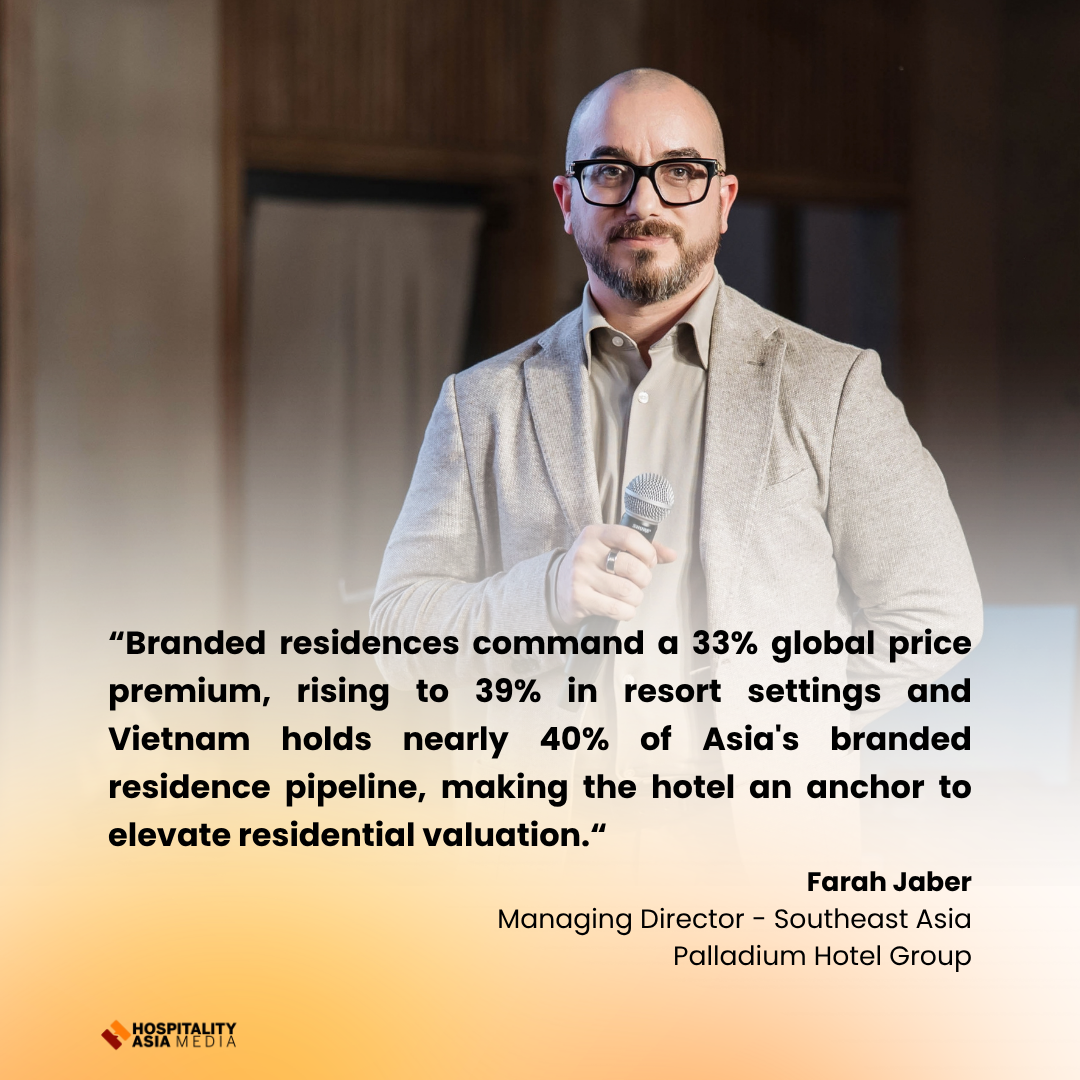
Farah Jaber: Operators must understand how asset owners generate real returns. Most major hotel developments in Vietnam are mixed-use projects where developer profits depend on residential sales speed and price per square meter rather than hotel EBITDA alone. Branded residences command a 33% global price premium, rising to 39% in resort settings and Vietnam holds nearly 40% of Asia's branded residence pipeline, making the hotel an anchor to elevate residential valuation.
International operators must also focus on transparency and brand integrity. Many local developers are building their first internationally branded project, so taking time to clearly explain complex management agreements builds crucial long-term trust. When tested on upholding brand standards that require capital, standing firm protects the long-term value of both the brand and the owner's asset.

Portfolio Strategy & Operational Standards
Q: How do you strike a balance between preserving core European brand DNA and localizing guest touchpoints for Asian travelers?
Farah Jaber: I separate brand identity from operating standards to make regional adaptation manageable.
Brand identity stays intact globally. Originating from Ibiza and a 60-year family legacy, our distinct design, music, culinary concepts, and unpretentious atmosphere define our value, diluting them removes why owners choose us.
Operating standards, however, must be localized early in architectural design because they carry long-term capital and layout impacts. Variables like room mix, key size, back-of-house staffing, and F&B cover-to-key ratios vary significantly between Europe, Vietnam, and Thailand; miscalculating them for local guest demographics severely harms profit margins for decades.
Our approach is to preserve brand identity and core quality standards while adapting the operating model and design to local demand.
Q: What strategic levers allow a new regional player to break through the market and capture share from established incumbents?
Farah Jaber: Competing on management fees is ineffective, regional fees are already declining, and discounting signals a lack of confidence in your commercial value proposition.
Instead, our primary growth lever is our ability to solve complex asset briefs, such as unique sites that cannot fit a standard five-star box. Solving a distinct physical or operational challenge puts us in a far stronger position than competing in generic multi-operator RFPs.
Second, commercial clarity and speed win deals. Performance termination clauses now appear in over 90% of regional agreements, proving that owners buy certainty. The performance assumptions and contractual responsibilities we can stand behind are far more compelling than offering fee concessions.
Finally, decision-making structure creates a major advantage. As a family-controlled business, we offer direct access to decision makers and complex structural questions receive answers in a reasonable timeframe.
Commercial Execution, TRevPAR & Future Risk
Q: How can hotel operators build pricing power and defend rate integrity in destinations where aggressive price discounting is common?
Farah Jaber: Room rate is fundamentally a product question before it is a revenue management question. Operators typically discount when their product is easily substituted—if an identical experience exists 300 meters down the beach, price becomes the only lever, and no revenue software can defend a rate the experience does not justify.
Beyond product differentiation, three operational disciplines protect pricing power:
- Rate Discipline During Ramp-Up: Conceding rate in year one is extraordinarily hard to recover by year three, making it commercially wiser to hold target rates at lower initial occupancy and budget accordingly. This requires a realistic ramp-up plan, that accounts for cash flow, during a hotel’s opening so rates are protected.
- Net Rate Analysis: Headline rates are misleading when OTAs handle roughly 83% of Asia Pacific bookings while direct web share has dropped to around 11%.
- Strict Parity Enforcement: Uncontrolled rate leakage across third-party channels directly undermines brand equity and pricing power.
Q: What non-rooms revenue streams offer the highest margins for regional resort assets to maximize Total Revenue Per Available Room (TRevPAR)?
Farah Jaber: Gross operating profit per available room in Asia Pacific averages around US$53 against US$105 in the Americas, despite Southeast Asia maintaining healthy 37% gross operating margins. The primary shortfall is revenue density per room rather than cost control.
Three specific non-rooms revenue streams that contribute to overall profitability are:
The contribution of each activity should be assessed after operating costs and the capital investment required. Each stream also requires a dedicated leader and an independent P&L to achieve optimal returns.
Q: What macro disruptions must regional hospitality leaders prepare their assets for over the coming decade?
Farah Jaber: Four primary risks require strategic preparation and capital allocation. Supply concentration is the most immediate, where record regional pipelines heavily weighted toward luxury mean that underwriting a resort today based on current market rates creates severe rate vulnerability by 2028. The second is residential dependency, where projects relying heavily on residential sales velocity to cross-subsidize hotel operations must stress-test those capital assumptions. The third is climate and infrastructure resilience, as coastal assets are being designed to storm and flood parameters that are already obsolete while insurance premiums reprice rapidly. The fourth is rising distribution overhead, as third-party channel costs continue to climb while direct booking shares decline, directly reducing the net margin delivered to the asset owner.
Q: As you spearhead this regional expansion across Southeast Asia, what single operational standard or strategic legacy do you hope to establish for the group's presence in Asia over the coming decade?
Farah Jaber: I want the properties we open in Asia to be judged on whether they were genuinely worth building, rather than how quickly the management contracts were signed.
The pressure in a fast-growing market always pushes toward volume, key counts, and rapid press announcements. However, a hotel management agreement is a 20-to-30-year operational commitment, and this region will soon discover which assets currently under construction were underwritten with realistic fundamentals.
We intend to grow rapidly where the market opportunity aligns with our strategy across Vietnam, Thailand, Indonesia, and the Indian Ocean. In ten years, the total deal count will matter far less than whether each property stands as the premier asset in its micro-market, whether fee streams remained resilient through economic cycles, and whether our owner-partners would choose to build with us again.
If our lasting legacy is that our leadership turned down deals it should have declined and protected brand standards when doing so required conviction, everything else will follow naturally.
Farah Jaber: Gross operating profit per available room in Asia Pacific averages around US$53 against US$105 in the Americas, despite Southeast Asia maintaining healthy 37% gross operating margins. The primary shortfall is revenue density per room rather than cost control.
Three specific non-rooms revenue streams that contribute to overall profitability are:
- Destination Food and Beverage: F&B represents the largest opportunity, with Vietnam F&B profit margins averaging around 41%, among the highest in Asia Pacific and nearly triple Australia's return. Venues must run as independent destination restaurants with dedicated entrances and culinary authority.
- Weddings and Events: Purpose-built event spaces paired with strong local planner relationships generate high-margin revenue independent of initial room occupancy ramps.
- Programmed Wellness: Spas drive high yield when offering structured, intent-driven wellness programming rather than functioning merely as real estate with treatment rooms.
The contribution of each activity should be assessed after operating costs and the capital investment required. Each stream also requires a dedicated leader and an independent P&L to achieve optimal returns.
Q: What macro disruptions must regional hospitality leaders prepare their assets for over the coming decade?
Farah Jaber: Four primary risks require strategic preparation and capital allocation. Supply concentration is the most immediate, where record regional pipelines heavily weighted toward luxury mean that underwriting a resort today based on current market rates creates severe rate vulnerability by 2028. The second is residential dependency, where projects relying heavily on residential sales velocity to cross-subsidize hotel operations must stress-test those capital assumptions. The third is climate and infrastructure resilience, as coastal assets are being designed to storm and flood parameters that are already obsolete while insurance premiums reprice rapidly. The fourth is rising distribution overhead, as third-party channel costs continue to climb while direct booking shares decline, directly reducing the net margin delivered to the asset owner.
Q: As you spearhead this regional expansion across Southeast Asia, what single operational standard or strategic legacy do you hope to establish for the group's presence in Asia over the coming decade?
Farah Jaber: I want the properties we open in Asia to be judged on whether they were genuinely worth building, rather than how quickly the management contracts were signed.
The pressure in a fast-growing market always pushes toward volume, key counts, and rapid press announcements. However, a hotel management agreement is a 20-to-30-year operational commitment, and this region will soon discover which assets currently under construction were underwritten with realistic fundamentals.
We intend to grow rapidly where the market opportunity aligns with our strategy across Vietnam, Thailand, Indonesia, and the Indian Ocean. In ten years, the total deal count will matter far less than whether each property stands as the premier asset in its micro-market, whether fee streams remained resilient through economic cycles, and whether our owner-partners would choose to build with us again.
If our lasting legacy is that our leadership turned down deals it should have declined and protected brand standards when doing so required conviction, everything else will follow naturally.
About Farah Jaber
Farah Jaber is the Managing Director, Southeast Asia for Palladium Hotel Group, leading the group’s strategic entry, brand development, and operational growth across Asia Pacific. With more than 15 years of executive experience across Thailand, Vietnam, Malaysia, the UAE, the Maldives, and the Seychelles, Jaber has held senior leadership roles with Minor Hotels, One&Only Resorts, and Emaar Hospitality Group. He specializes in luxury resort development, brand positioning, owner relations, and driving commercial yield across complex hospitality portfolios.