
Austin Jones on Capturing the White Space in Bali’s New Hospitality Landscape
17.09.2026
3 Key Takeaways
- The White Space in Ubud: While Ubud is saturated with eco-lodges, wellness retreats, and traditional ultra-luxury estates, it lacks a true socially magnetic lifestyle hotel where public spaces and local F&B drive non-rooms yield.
- Specific Positioning Over Volume: In a maturing Bali market, long-term asset performance relies on building fewer keys with a distinct point of view rather than chasing capacity or relying on generic luxury formulas.
- Unscripted Service as a Commercial Driver: Operational SOPs establish the baseline floor, but unscripted human warmth creates the long-term memories that drive repeat bookings and direct guest retention.
The launch of Kimpton Suntaya Bali Ubud marks a landmark expansion for IHG Hotels & Resorts, introducing the pioneering Kimpton luxury lifestyle brand to Indonesia for the very first time. Situated on Jalan Bisma along the sacred Wos River in Ubud’s cultural heart, the 101-key property features a contemporary interpretation of Balinese architecture by Denton Corker Marshall, combining essential rooms, expansive pool suites, and private pool villas with five distinctive culinary destinations and dedicated contrast-therapy wellness facilities.
At the helm of this launch is Austin Jones, General Manager of Kimpton Suntaya Bali Ubud. Having contributed to the opening and operation of nearly a dozen Kimpton properties globally, Jones brings a deep understanding of lifestyle-driven hospitality to Indonesia's debut property.
In this exclusive interview, Jones details the commercial strategy behind Kimpton Suntaya Bali Ubud, the structural shifts transforming Bali’s tourism economy, the white space in Ubud’s luxury landscape, and how unscripted human service drives long-term asset value.
Crafting a Brand That Truly Belongs
Q: Kimpton is an unusual brand to be asked about brand consistency vs. localization, because Bill Kimpton essentially answered it in 1981. How do you maintain the brand's core framework while ensuring the property genuinely belongs to its local destination?
Austin Jones: Bill Kimpton built small neighborhood hotels with restaurants good enough to draw locals, establishing a model most of the industry follows today. For us, the core instruction is simply to be different. The global framework provides values, safety, financial discipline, and IHG’s distribution platforms, while allowing staff to be themselves.
Everything the guest touches, design, food, music, and daily rituals, must evolve locally. In Bali, culture is a functioning religious and social system that operates daily. Importing a generic template fails here because guests instantly spot the difference between a property that naturally belongs and one merely dressed up to look local.
Q: How do you define lifestyle luxury, and what makes this model commercially attractive and resilient compared to traditional luxury resort models?
Austin Jones: Traditional luxury sells space, privacy, and flawlessness, where the room is the central product and service is formal. Lifestyle luxury sells a place worth being in, making public spaces the product through curated design, food, music, and social energy.
Commercially, lifestyle hospitality diversifies income streams beyond room nights. While traditional luxury resorts depend heavily on seasonal room revenue, lifestyle properties generate consistent yield from local dining, active bars, events, and wellness. This creates a much more resilient P&L during room rate fluctuations. To succeed, operators must avoid mild compromises and clearly designate which spaces are built for energy and which are built for quiet retreat.
Driving Total Asset Yield in a Maturing Market
Q: Bali's tourism ecosystem has undergone a massive structural transformation post-pandemic. How do you read these changing demand patterns, and what macro signals indicate where Bali's tourism economy is heading over the next 5 to 10 years?
Austin Jones: The most reliable signal isn't found in raw arrival numbers, but in decisive policy shifts. Six regional regencies have agreed to halt development permits on productive agricultural land, hotel and restaurant taxes are being redistributed to underfunded infrastructure, and dedicated tourist levies are funding transport and environmental solutions. These are not signs of a market in distress, they signal a maturing tourism economy actively transitioning from volume-driven expansion to long-term destination management.
On the demand side, traveler behavior has fundamentally shifted. Guests are no longer simply buying luxury for its own sake; they are buying intent. We are seeing a shift toward fewer, longer, and far more deliberate trips where travelers willingly pay a premium for distinct, high-conviction experiences, but have zero tolerance for generic concepts.
Over the next decade, this trajectory favors strategic specificity over physical scale. The era of constructing 300-key resorts under the assumption that island demand will automatically absorb them is over. Long-term market leadership will belong to operators who intentionally build smaller key counts, prioritize deep personalization, and offer a clear cultural point of view that gives travelers a compelling reason to visit beyond the standard beach-and-pool formula.
Q: From a hotel market perspective, what makes Bali uniquely resilient as an asset class, and where are the operational vulnerabilities that hoteliers must be cautious of in the current economic climate?
Austin Jones: I lived in Bali for close to three years and then left, and I kept feeling pulled back. What actually drew me back was the community, the food, the rituals, the weather, the pace of life, and the strange fact that you have access to almost everything despite being on a relatively remote island.
Bali’s resilience is structural because the island caters to travelers across multiple life stages, regenerating demand naturally over time. Most destinations give you one reason to come. Bali gives you a different reason at every stage of your life. However, hoteliers face three main operational vulnerabilities:
Q: Ubud is one of the most densely populated luxury markets in Asia. Where is the Ubud luxury market currently oversupplied, and where do you see the remaining white space for new luxury entries looking to capture market share?
Austin Jones: Ubud is saturated across three traditional categories: eco-lodges, wellness retreats, and ultra-luxury estates.
What Ubud does not have is a lifestyle hotel. There is no property here doing what Proper does, or what Hoxton does. Nowhere that is fun and socially magnetic, where the bar has a reason to exist beyond serving in-house guests, where the public space is the product, where you'd want to be on a Thursday night whether or not you were staying there. That energy simply doesn't exist in this market, and it is the single thing lifestyle hotels are famous for. That is the white space, and it's what Kimpton Suntaya is being built to fill.
Austin Jones: The most reliable signal isn't found in raw arrival numbers, but in decisive policy shifts. Six regional regencies have agreed to halt development permits on productive agricultural land, hotel and restaurant taxes are being redistributed to underfunded infrastructure, and dedicated tourist levies are funding transport and environmental solutions. These are not signs of a market in distress, they signal a maturing tourism economy actively transitioning from volume-driven expansion to long-term destination management.
On the demand side, traveler behavior has fundamentally shifted. Guests are no longer simply buying luxury for its own sake; they are buying intent. We are seeing a shift toward fewer, longer, and far more deliberate trips where travelers willingly pay a premium for distinct, high-conviction experiences, but have zero tolerance for generic concepts.
Over the next decade, this trajectory favors strategic specificity over physical scale. The era of constructing 300-key resorts under the assumption that island demand will automatically absorb them is over. Long-term market leadership will belong to operators who intentionally build smaller key counts, prioritize deep personalization, and offer a clear cultural point of view that gives travelers a compelling reason to visit beyond the standard beach-and-pool formula.
Q: From a hotel market perspective, what makes Bali uniquely resilient as an asset class, and where are the operational vulnerabilities that hoteliers must be cautious of in the current economic climate?
Austin Jones: I lived in Bali for close to three years and then left, and I kept feeling pulled back. What actually drew me back was the community, the food, the rituals, the weather, the pace of life, and the strange fact that you have access to almost everything despite being on a relatively remote island.
Bali’s resilience is structural because the island caters to travelers across multiple life stages, regenerating demand naturally over time. Most destinations give you one reason to come. Bali gives you a different reason at every stage of your life. However, hoteliers face three main operational vulnerabilities:
- Rapid Concept Replication: Successful concepts are quickly copied across neighborhoods, compressing market rates.
- Rate vs. Occupancy Decoupling: Luxury ADR has risen while overall occupancy softened, meaning discounting to fill beds will damage long-term brand equity.
- Infrastructure Constraints: Regional road, water, and waste capacities represent real limits on growth.
Q: Ubud is one of the most densely populated luxury markets in Asia. Where is the Ubud luxury market currently oversupplied, and where do you see the remaining white space for new luxury entries looking to capture market share?
Austin Jones: Ubud is saturated across three traditional categories: eco-lodges, wellness retreats, and ultra-luxury estates.
What Ubud does not have is a lifestyle hotel. There is no property here doing what Proper does, or what Hoxton does. Nowhere that is fun and socially magnetic, where the bar has a reason to exist beyond serving in-house guests, where the public space is the product, where you'd want to be on a Thursday night whether or not you were staying there. That energy simply doesn't exist in this market, and it is the single thing lifestyle hotels are famous for. That is the white space, and it's what Kimpton Suntaya is being built to fill.

Q: Historically, Bali's lifestyle sector was dominated by coastal hubs, while Ubud was treated as a quiet sanctuary. How has the luxury traveler redefined what inland destinations should offer, and how is the line between lifestyle hospitality and traditional sanctuary blurring?
Austin Jones: Something fundamental shifted in how people view travel, and I don't think our industry has fully caught up to it yet. Before the pandemic, travel was largely treated as discretionary. That turned travel from a passive luxury into something much closer to a human need. And once it becomes a need, the calculation changes completely. When you accept that you only have a finite number of these trips in your lifetime, you begin asking what each one actually gives back to your soul. Travelers started looking for travel with genuine depth.
That depth is precisely what Ubud offers and it offers it effortlessly. It is a ceremonial procession you happen to walk into on the street, praying alongside locals in a water palace that has stood for centuries, or sitting quietly with an artisan whose family has crafted the exact same art for six generations.
The hospitality industry keeps using the word "authentic" without really understanding what it means. Hoteliers slap it onto packaged experiences without considering the underlying psychology of what a guest is actually searching for and guests feel the difference immediately between something genuine and something being performed for them.
The word I choose to use instead is depth. Depth is what somebody remembers ten years later. Ubud has it built into its very fabric, and rather than trying to build a jungle version of a coastal beach club, is the true reason why high-end lifestyle demand continues to move inland.
Q: How are changing visitor demographics altering demand for length of stay, room inventory mix (villas vs. suites), and non-rooms spend across luxury properties?
Austin Jones: There are a few opposing factors at play here. First, length of stay is stretching at both ends. We see remote workers staying three to four weeks alongside regional travelers from Singapore, Jakarta, Seoul, and Sydney taking multiple three-night getaways a year. Serving both profiles without compromising either requires an adaptable operational model.
Second, our approach to inventory has evolved. The traditional assumption that private villas are the default premium product is shifting. Multi-generational families want space and connected layouts, but they also want proximity to the property's central energy rather than isolation at the edge of the resort. Finally, non-rooms revenue is where we see the most significant shift. Long-stay guests consume more meals on-site, while frequent short-stay guests choose a hotel primarily for its surrounding ecosystem rather than the room itself. Food, beverage, and wellness are no longer secondary amenities; they are primary drivers of the initial booking.
Occupancy will always matter, but the metric I monitor most closely is active hours spent on property per day. When guests deliberately choose to spend their time within your communal spaces, that engagement translates directly to non-rooms revenue.
Q: How does a property bridge the location trade-off between central accessibility and secluded nature?
Austin Jones: Our location on Jalan Bisma places us in central Ubud, yet the site's natural valley topography eliminates urban noise on-property. Resolving this trade-off relies on master planning, deliberately zoning quiet vs. active areas, and maintaining the discipline to build fewer keys. Over-building to maximize room density destroys the natural buffer required for a central property to feel serene.
Q: How do organized luxury resorts strategically overcome the competitive dynamic posed by standalone private luxury villas?
Austin Jones: Standalone villas offer complete privacy, but lack service infrastructure and communal energy. After a few days, villa guests face the friction of managing local logistics and dining reservations independently.
A hotel's advantage is the presence of decisions. You come downstairs and dinner is solved, someone remembers how you take your coffee, there's a class at seven and nobody minds if you skip it, and when something goes wrong at two in the morning, a person fixes it. That accumulation of small removals is worth far more than most operators price it at.
Organized luxury resorts win by removing decision friction. Properties provide curated F&B, effortless service, structured programming, and social connection, delivering a level of convenience and atmosphere that standalone private villas cannot match.

Why Unscripted Moments Outperform Hardware
Q: What is the commercial key for hotel-operated dining venues to break through the local noise, capture non-resident foodies, and drive high TRevPAR in an independent culinary capital like Ubud?
Austin Jones: The commercial key to hotel dining is simple: you have to earn a local’s Tuesday night. If residents choose your venue over a hundred independent options, TRevPAR takes care of itself. Achieving that requires five strategic choices:
Q: How are modern luxury properties restructuring their wellness hardware and software to capture higher margins from longevity and wellness-driven travelers?
Austin Jones: The post-pandemic shift toward longevity has led many operators into the trap of treating wellness purely as a hardware problem, investing heavily in hyperbaric chambers, plunge pools, and red-light devices. While wellness technology has advanced significantly, relying strictly on expensive machinery creates a short-lived novelty that guests try once and rarely repeat.
At Kimpton Suntaya, we view wellness through a software-first lens. The true test of a program is take-home utility: when guests integrate sustainable habits like breathwork, functional movement, or sleep routines into their daily lives, your brand becomes permanently linked to their long-term well-being. True wellness must be fully integrated across nutrition, sleep, movement, and social connection throughout the day rather than confined to a isolated, one-hour spa treatment. This approach is also commercially superior—group programming scales effortlessly across multiple guests without adding linear labor costs, driving significantly higher operating margins than traditional spa treatments.
Q: In an era of standardized luxury SOPs, how does shifting toward unscripted, human-centric hospitality act as a true commercial driver for retention and equity?
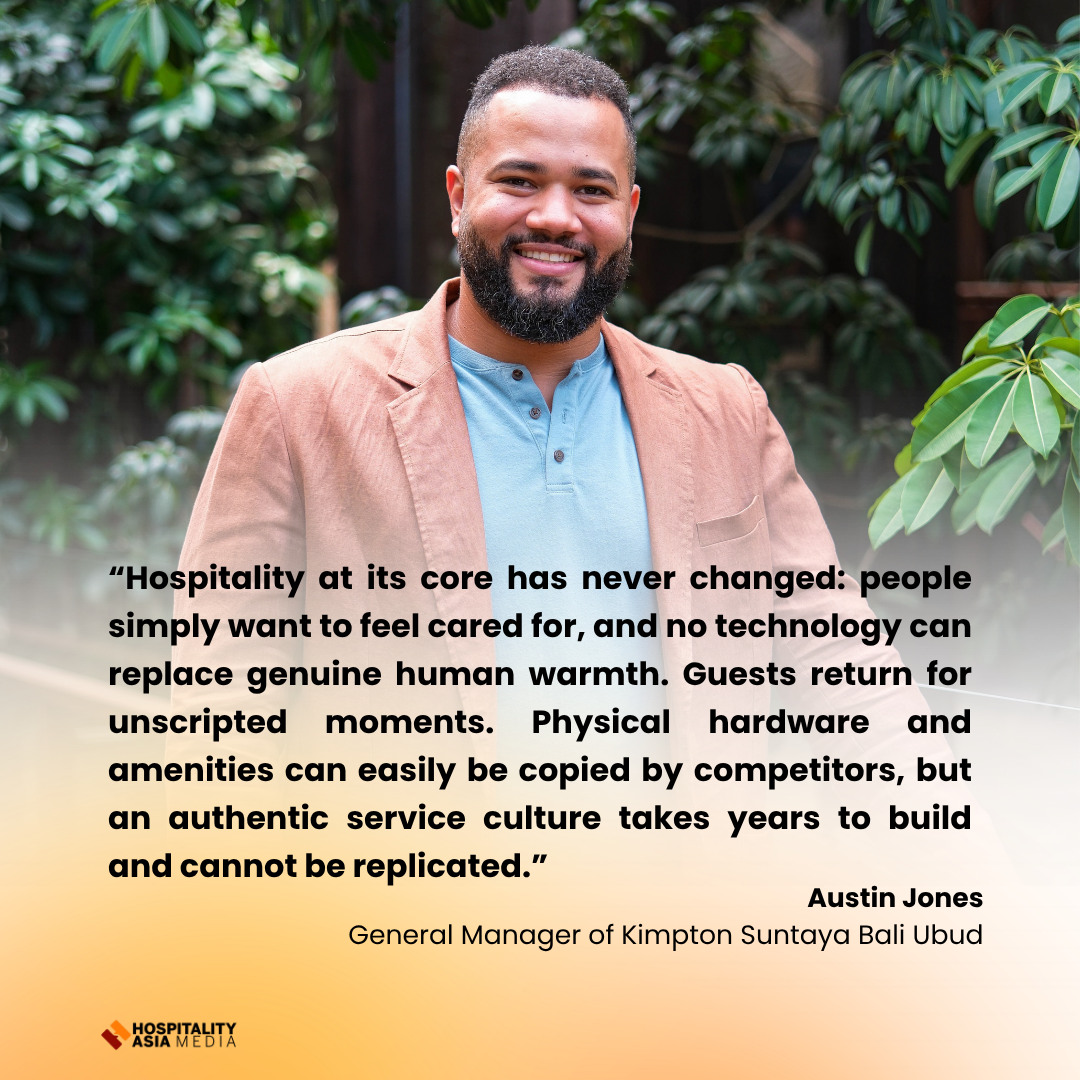
Austin Jones: Hospitality at its core has never changed: people simply want to feel cared for, and no technology can replace genuine human warmth. Operational standards establish the baseline, ensuring clean rooms, hot coffee, and accurate billing, but smooth logistics alone do not create lasting memories.
Guests return for unscripted moments, like a doorman remembering their child's name or a bartender staying late for a great conversation. This human-centric approach is a clear commercial driver. Physical hardware and amenities can easily be copied by competitors, but an authentic service culture takes years to build and cannot be replicated. By hiring for natural warmth and training for operational execution, hotels create the unscripted experiences that ultimately drive repeat stays, direct bookings, and long-term brand equity.
Q: What is the single biggest misconception hoteliers have when entering a mature market like Bali, and what mindset shift is required to build a property that truly stands out?
Austin Jones: The biggest misconception is that a mature, competitive market requires being louder or larger. In a saturated landscape, success requires extreme strategic specificity rather than high volume.
Operators must realize they are joining an established local community. Building a lasting property requires respecting the destination's cultural depth and ensuring the concept delivers long-term value to both visitors and the surrounding neighborhood.
Austin Jones: The commercial key to hotel dining is simple: you have to earn a local’s Tuesday night. If residents choose your venue over a hundred independent options, TRevPAR takes care of itself. Achieving that requires five strategic choices:
- Chef-Driven Authority: The kitchen must be led by a chef with a distinct culinary voice and the freedom to execute it, not an F&B team managing a consultant's generic template.
- A Focused Point of View: Menus cannot try to satisfy every hotel guest. The moment you design a concept around catering to everyone, it becomes uninteresting to anyone outside the hotel.
- Meaningful Storytelling: Meals need substance over pure theater—guests care about ingredient origins, local producers, and why a dish exists on the plate.
- Natural Service: Stiff, formal service signals a transactional hotel environment. Staff interactions should feel warm, unscripted, and approachable.
- Open Positioning: Properties must remove physical and psychological barriers to entry. Venues should operate as welcoming neighborhood restaurants that happen to be inside a resort, rather than gated hotel facilities.
Q: How are modern luxury properties restructuring their wellness hardware and software to capture higher margins from longevity and wellness-driven travelers?
Austin Jones: The post-pandemic shift toward longevity has led many operators into the trap of treating wellness purely as a hardware problem, investing heavily in hyperbaric chambers, plunge pools, and red-light devices. While wellness technology has advanced significantly, relying strictly on expensive machinery creates a short-lived novelty that guests try once and rarely repeat.
At Kimpton Suntaya, we view wellness through a software-first lens. The true test of a program is take-home utility: when guests integrate sustainable habits like breathwork, functional movement, or sleep routines into their daily lives, your brand becomes permanently linked to their long-term well-being. True wellness must be fully integrated across nutrition, sleep, movement, and social connection throughout the day rather than confined to a isolated, one-hour spa treatment. This approach is also commercially superior—group programming scales effortlessly across multiple guests without adding linear labor costs, driving significantly higher operating margins than traditional spa treatments.
Q: In an era of standardized luxury SOPs, how does shifting toward unscripted, human-centric hospitality act as a true commercial driver for retention and equity?
Austin Jones: Hospitality at its core has never changed: people simply want to feel cared for, and no technology can replace genuine human warmth. Operational standards establish the baseline, ensuring clean rooms, hot coffee, and accurate billing, but smooth logistics alone do not create lasting memories.
Guests return for unscripted moments, like a doorman remembering their child's name or a bartender staying late for a great conversation. This human-centric approach is a clear commercial driver. Physical hardware and amenities can easily be copied by competitors, but an authentic service culture takes years to build and cannot be replicated. By hiring for natural warmth and training for operational execution, hotels create the unscripted experiences that ultimately drive repeat stays, direct bookings, and long-term brand equity.
Q: What is the single biggest misconception hoteliers have when entering a mature market like Bali, and what mindset shift is required to build a property that truly stands out?
Austin Jones: The biggest misconception is that a mature, competitive market requires being louder or larger. In a saturated landscape, success requires extreme strategic specificity rather than high volume.
Operators must realize they are joining an established local community. Building a lasting property requires respecting the destination's cultural depth and ensuring the concept delivers long-term value to both visitors and the surrounding neighborhood.
About Austin Jones
Austin Jones is the General Manager of Kimpton Suntaya Bali Ubud, overseeing the strategic positioning, pre-opening, and operational execution of the property. With an extensive international career in lifestyle hospitality, Jones specializes in launching concepts that blend global commercial standards with local cultural integration. His operational approach focuses on driving non-rooms revenue, establishing chef-driven culinary destinations, and building service cultures rooted in authentic human connection.